Military spending and its trade-offs: Peace and development hang in the balance
Are rising defense budgets building peace or limiting progress towards sustainable development?
The rapid increase in military expenditure is reshaping global security, peace, and development. The facts lie bare before us: in 2024, military spending reached a record $2.7 trillion, while the financing gap for achieving the Sustainable Development Goals (SDGs) stands at $4 trillion annually.
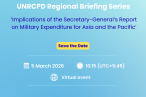
Against this backdrop, in commemoration of this year's International Day for Disarmament and Non-Proliferation Awareness on the 5th of March, the United Nations Regional Centre for Peace and Disarmament in Asia and the Pacific (UNRCPD) launched its online Regional Briefing Series. The first session focused on what the United Nations Secretary-General’s report ‘The Security We Need: Rebalancing Military Spending for a Sustainable and Peaceful Future’ means for Asia and the Pacific.
The discussion, moderated by Mr. Deepayan Basu Ray, Director of UNRCPD, explored the interconnected themes surrounding issues of disarmament, military expenditure, accountability and transparency, emerging technologies and their implications and youth engagement.
Speakers included:
- Ms. Claudia Garcia Guiza, Political Affairs Officer, United Nations Office for Disarmament Affairs (UNODA)
- Dr. Manpreet Sethi, Senior Research Adviser, Asia-Pacific Leadership Network (APLN)
- Mr. I Gusti Agung Wesaka Puja, Executive Director, ASEAN Institute for Peace and Reconciliation (ASEAN-IPR)
- Dr. Lucie Béraud-Sudreau, Shangri-La Senior Fellow for Indo-Pacific Defence Policy, Economics and Industry, International Institute for Strategic Studies (IISS-Asia),
The panel reflected on the contrast between record-high global military spending and the widening financing gap of the SDGs and its implications for the Asia-Pacific.
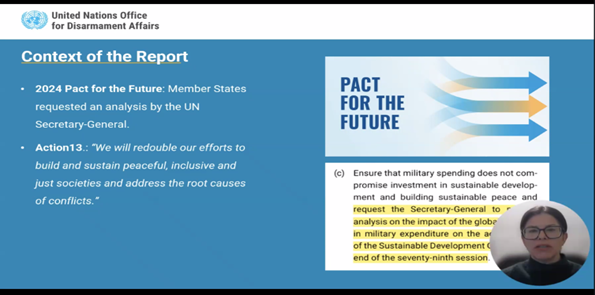
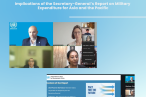
Photo 1: UNODA presenting the United Nations Secretary-General's report on Military Expenditure
Background and Context
The event opened with a recorded briefing laying down the foundational context of the Secretary-General's report. The report was developed in response to Action 13(c) of the Pact for the Future, which requested the analysis of the impact of rising global military expenditure on the achievement of SDGs.
The briefing emphasised that 2024 marks the tenth consecutive year of increasing military expenditure. This trend becomes more concerning when we realise that less than 4% of the current global military spending could be sufficient to eradicate world hunger. Further compounding this issue, in developing countries, even a 1% increase in military expenditure is linked to an almost equal reduction in publicly financed health services.
The current global landscape was described as troubled convergence of contested multilateralism, worsening global security conditions, and rising military spending. Further compounding this scenario is the re-emergence of a nuclear arms race, one that is acutely influenced by the integration of artificial intelligence.
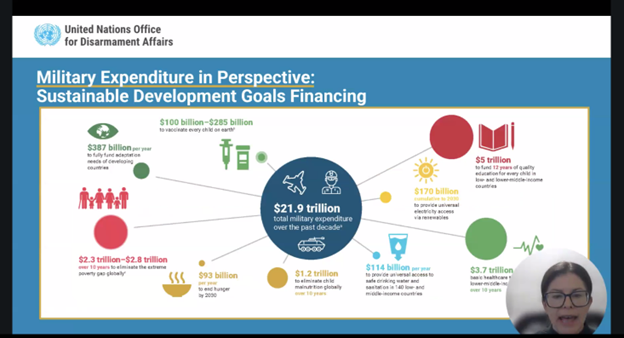
Photo 2: UNODA presenting the United Nations Secretary-General's report on Military Expenditure
Military Spending, Development, and the Security Trade-Off
Presenters highlighted the recommendations of the report and an urgent need for the world to take action. Stakeholders were encouraged to:
- share their findings to raise awareness;
- break down institutional silos between peace, security and development sectors; and
- advocate for the inclusion of disarmament perspectives in the post-2030 development agenda.
Presenters noted that the world stands at a crossroads: one path leads to escalating arms races and compressed fiscal space for human development; while the other offers a route toward mutual security and prosperity through diplomacy, cooperation, and sustainable investment.
The panellists highlighted the inverse relationship between military spending and multilateral cooperation. As military spending and stockpiling rise, forums for multilateral cooperation shrink. In parallel, the perceptions of threat (real or imagined) heighten to a state where avenues of partnership significantly reduce, even on issues of shared concern. The discussion stressed the need to distinguish between security based on weapons accumulation, and peace through investment in development, while also recognizing the issue of addressing legitimate security concerns without over-reliance on military build-up.
In the context of military stockpiling, smaller States often carry a disproportionate burden as they are left with little choice but to follow the lead of the powerful. This often comes at the cost of socio-economic investment in themselves. As one speaker put it, in the race for military dominance, "Big nations set the fashion on power street."
Questions were also raised about how countries can responsibly reduce defence budgets when adversaries continue to build up their arsenals. Participants also asked how disarmament education can be embedded in national school curricula to help shift broader social mindsets around security. One participant further called for an urgent, enforceable mechanism to regulate the military use of AI tools, pointing to recent reports of civilian-developed systems being deployed in attacks with limited public accountability or legal oversight.
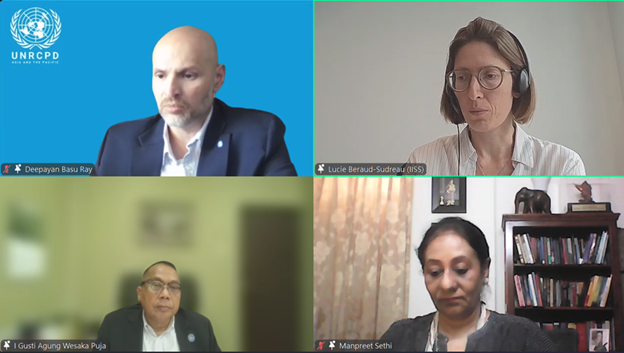
Photo 3: Panelists discussing various issues surrounding military expenditure and regional security
Global Disarmament and Multilateral Frameworks
Reflecting on the wider global disarmament landscape, speakers invoked Frédéric Bastiat's well-known observation that "when goods do not cross borders, soldiers will," to underscore the close relationship between economic cooperation, security and peace. The panelists pointed to a challenge to multilateralism itself in recent years. Frameworks such as the Comprehensive Nuclear Test-Ban Treaty remains deadlocked. The review process of the Nuclear Non-Proliferation Treaty is under mounting strain. The New Strategic Arms Reduction Treaty has lapsed with no agreed upon successor in sight. The landmines treaty has lost states parties in the past year. These discussions opened the floor to a wide range of pressing questions. Participants asked whether advancements in science and technology — particularly in artificial intelligence and autonomous drone systems — serve humanity or deepen the dangers of modern conflict. This was especially important to explore given low-cost, high-autonomy weapons challenge traditional assumptions about military power and expenditure.
Regional Perspectives: Asia-Pacific
Turning to regional organizations, while the Association of Southeast Asian Nations (ASEAN) has remained relatively stable, however, the region must sharpen its ability to spot early warning signs and activate existing mechanisms before tensions spiral into conflict.
It was also recommended to make use of platforms such as the ASEAN Regional Forum and the ASEAN Defense Ministers' Meeting — both being essential tools for managing tensions and preserving stability.
The discussion also acknowledged the role of cooperation between regional and multilateral organizations in advancing the goals of shared peace and security, including the achievement of the SDGs. This cooperation is paramount to building a stable and peaceful Asia-Pacific region.
Drawing on data from The Military Balance 2026, which reported that Asian defense budgets reached $573 billion in 2025, the panelists explored how these trends reflect heightened threat perceptions. They noted that threat perceptions are often regional, thus necessitating regional solutions. Reversing spending trends requires addressing the core reasons of why populations feel threatened. The importance of transparency, public accountability in defense budgeting, and ensuring that military expenditures deliver capabilities proportionate to their cost was also stressed upon.
Participants also sought views on how small States can safeguard their security without being drawn into great-power rivalries — a tension felt acutely across the Asia-Pacific. They also asked: where is the youth in all of this? How can young people meaningfully engage with the UN to shape disarmament outcomes — and ultimately, their own futures?

Photo 4: Dr. Béraud-Sudreau and Mr. Basu Ray discussing themes of the event
Civil Society, Education, and Accountability
While these are complex issues, speakers noted that real action can be taken through public education, particularly by targeting the youth. This includes expanding the definition of security to not only include military strength, but to also address concerns of health, education, social infrastructure, and climate action. Coordinated efforts must be taken to shift perceptions on what constitutes "real" security. The empowerment of civil society and parliamentary bodies to strengthen accountability and transparency in military expenditure is key. Subjecting such spending to the same scrutiny as other areas of public expenditure is essential for measurable change.
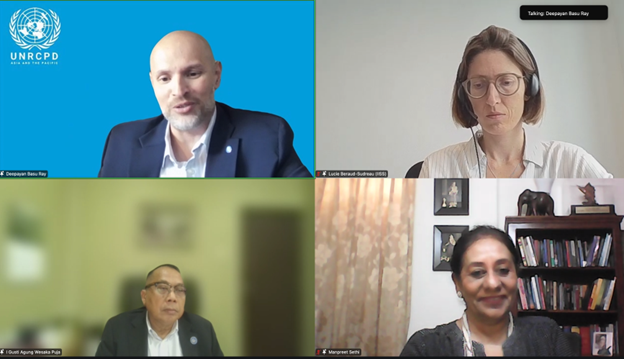
Photo 5: Panelists amid answering questions posed by attendees
The panelists closed with a stark warning: militarization is accelerating while climate change threatens our collective survival — and this arms buildup isn't confined to major powers. It's a global trend.
Nevertheless, there is room for cautious optimism. Regional cooperation and coordination, accountability and transparency, and the involvement of diverse stakeholders in disarmament dialogues represent promising steps forward in an otherwise challenging landscape.
UNRCPD continues to advance disarmament education in the region through meaningful dialogue. The launch of the Regional Briefing Series reflects this ongoing effort, and UNRCPD looks forward to continuing the series through events that bring together experts, amplify regional voices, and deepen discussion on the Asia-Pacific context.
Read the report
Readers are encouraged to review the United Nations Secretary-General’s report on military expenditure and its accompanying fact sheet.
Report: https://disarmament.unoda.org/en/milex-sdg-report/report-secretary-general-global-impact-increasing-military-expenditure-sdgs
Fact sheet: https://www.un.org/sites/un2.un.org/files/milex-docs/MILEX_UN_Fact_Sheet.pdf
For more information, contact unrcpd-info@un.org.