
Office for Disarmament Affairs
Regional Centre for Peace and Disarmament
in Asia and the Pacific
Spotlights
See the top, latest stories and events coming from UNODA.
Updates
See the top, latest stories and events coming from UNODA.
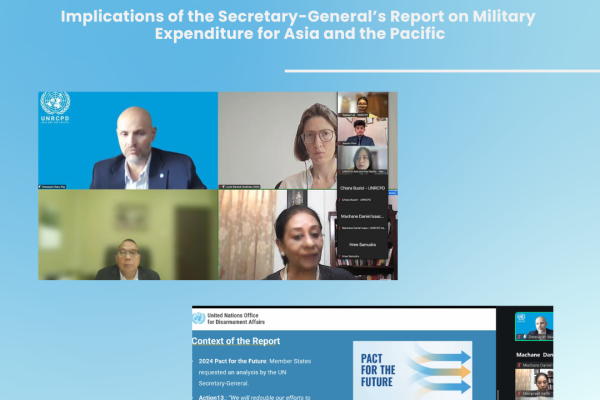
Military spending and its trade-offs: Peace and development hang in the balance
Are rising defense budgets building peace or limiting progress towards sustainable development?
The rapid increase in military expenditure is reshaping global security, peace, and development. The facts lie bare before us: in 2024, military spending reached a record $2.7 trillion, while the financing gap for achieving the Sustainable Development Goals (SDGs) stands at $4 trillion annually.
Against this backdrop, in commemoration of this year's International Day for…
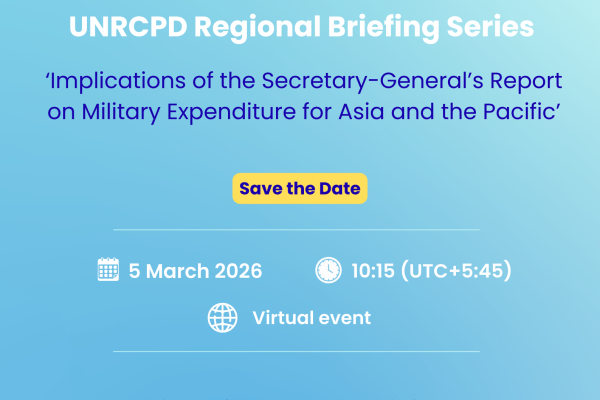
UNRCPD launches 2026 Regional Briefing Series with discussion on the Secretary-General’s military expenditure report
As military expenditure reaches new highs globally, questions are growing about how security priorities are set—and what the wider implications may be for development and human security. On 5 March 2026, as part of the International Day for Disarmament and Non-Proliferation Awareness (IDDNPA), the United Nations Regional Centre for Peace and Disarmament in Asia and the Pacific (UNRCPD) will launch its 2026 Regional Briefing Series with an online discussion of the United Nations Secretary-General’s report on military expenditure, “The Security We Need: Rebalancing Military Spending for a…
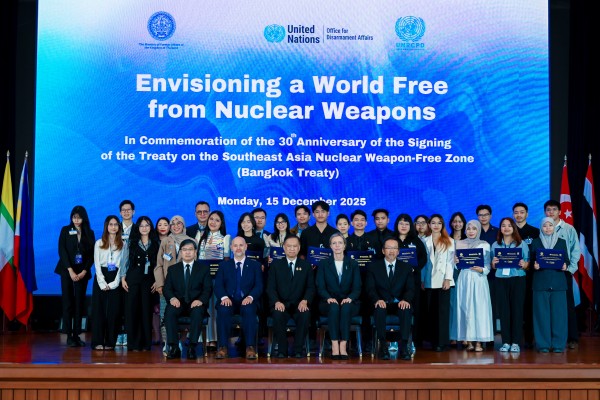
Envisioning a World Free from Nuclear Weapons
Youth Art, Dialogue and Skills Workshops for a Nuclear-Weapon-Free Southeast Asia
Marking 30 Years of the Southeast Asia Nuclear Weapons Free Zone Treaty (The Treaty of Bangkok)
BANGKOK - 15-17 December 2025
On the morning of 15 December, the halls of Thailand’s Ministry of Foreign Affairs filled with something one does not often see at disarmament commemorations: youth artworks.
Through the "Envisioning a World Free from Nuclear Weapons", a Youth Multimedia Arts Competition, photographs, films, and digital art—created by young people from…
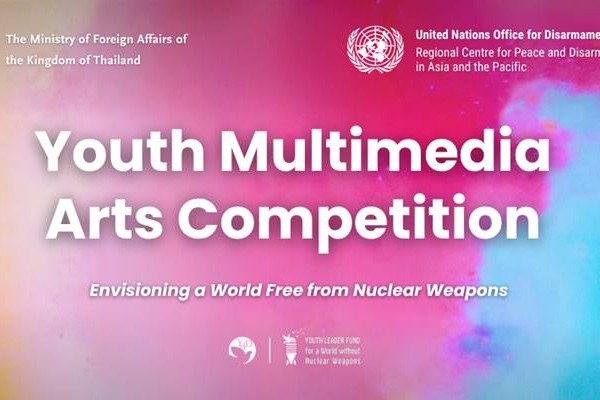
Winners of the Youth Multimedia Arts Competition: “Envisioning a World Free from Nuclear Weapons” Announced
To mark the 30th anniversary of the signing of the Treaty on the Southeast Asia Nuclear-Weapon-Free Zone (Treaty of Bangkok), the Government of Thailand and the United Nations Office for Disarmament Affairs (UNODA), through its Regional Centre for Peace and Disarmament in Asia and the Pacific (UNRCPD), launched the Youth Multimedia Arts Competition 2025: “Envisioning a World Free from Nuclear Weapons”. The initiative is also organized through the support from the Youth Leader Fund for a World without Nuclear Weapons (YLF), as a regional component of that programme, funded by the…
UNRCPD at a glance
UNRCPD assists countries in the region to achieve their peace, security, and disarmament goals
About
UNRCPD assists countries in the region to achieve their peace, security, and disarmament goals, through provision of substantive support; coordination of activities at the sub-regional, regional and international levels; and information sharing on global and regional activities.
Mandate
The Centre is mandated to provide, on request, substantive support for initiatives and other activities, mutually agreed upon by the Member States of the Asia-Pacific region, for the implementation of measures for peace and disarmament, and to coordinate the implementation of regional activities in Asia and the Pacific.
UNRCPD works to
Assist States in strengthening their capacity to fully implement UN Security Council Resolution 1540. Promote Peace and Disarmament Education to generate public awareness and support for global and regional disarmament efforts. Support states in ratification of and accession to the Arms Trade Treaty.
Areas of Focus
The Centre focuses its activities in three main areas: providing capacity building and technical assistance, creating and participating in dialogue fora, and engaging in outreach and advocacy on disarmament issues