
The future is written in binary.
The juggernaut of Artificial Intelligence (AI) has become a force which is already stamping its indelible mark on humanity. Technology of such significance is hard to contain, but giving it free reign would be irresponsible. The development and deployment of this technology is also happening largely outside government control. Thus, as humanity stands at the edge of history, it becomes imperative to advance discussions on AI, as both a boon and, if left unchecked, a bane.
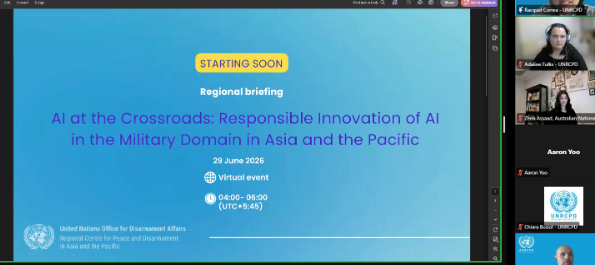
To give momentum to these efforts, on 29 June 2026, the United Nations Office for Disarmament Affairs’ (UNODA) Asia Pacific Regional Centre (UNRCPD); organized the second edition of its Regional Briefing Series, ‘AI at the Crossroads: Responsible Innovation of AI in the Military Domain in Asia and the Pacific’ in collaboration with UNODA’s Science, Technology and International Security Unit (STU). The briefing series provides a platform for dialogue on emerging peace and security challenges affecting Asia and the Pacific.
The event brought to light the ground realities of the development of AI with policymakers, technical experts, academicians, and civil society representatives being invited to put forward their thoughts on what is now referred to as the dual-use trajectory of artificial intelligence. This means that the same technology which can be used to make life changing breakthroughs in medicine can also be used to make illegal and difficult-to-regulate Improvised Explosive Devices (IEDs).
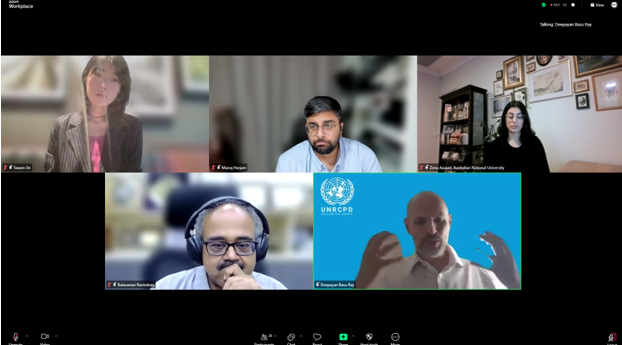
The speakers invited for this briefing reflected a segment of the stakeholders in the dual-use trajectory of AI, and included:
- Prof. B. Ravindran, Professor and Head of Wadhwani School of Data Science and Artificial Intelligence, IIT Madras
- Dr. Zena Assaad, Associate Professor in Engineering — Australian National University (ANU)
- Mr. Manoj Harjani, Research Fellow — S. Rajaratnam School of International Studies (RSIS), Singapore
- Ms. Swann Jin, Associate Political Affairs Officer, United Nations Office for Disarmament Affairs (UNODA), Science, Technology & International Security Unit (STU)
Mr. Deepayan Basu Ray, Director (UNRCPD), in his welcome remarks noted how AI had evolved from becoming a distant, emerging technology into an operational reality, not only reaching domains such as healthcare, cybersecurity, and public administration, but also becoming increasingly significant in daily lives across the Asia-Pacific and the world. Mr. Basu Ray emphasized how responsible innovation requires moving beyond questions of what AI can do, to explore what it should be used for, whom it affects, and what guardrails are necessary.

The difficulty of discerning whether an image was created using generative AI has grown alongside the rapid advancements that AI is making. In other words, it is getting harder and harder to differentiate a real image from one that has been artificially made. To put the participants of the briefing to the test, an interactive icebreaker titled ‘AI or Not? Risk Radar’, was facilitated by Ms. Racquel Correa, Associate Programme Management Officer (UNRCPD). Participants were asked to evaluate a series of images ranging from natural landscapes to military operations and disaster scenarios, and to then vote on whether each was AI-generated or authentic.
Recurring signals pointing to AI generated content were also discussed. This exercise helped show the widespread difficulty in separating doctored content from authentic, an especially concerning trend given the implications of AI generated content being treated as real information, including the dissemination of fake news, misinformation, and undue influence, which can contribute to risks ranging from abuse to conflict, and unrest.
Using this ambiguity, focus turned to broader dual-use risks, noting how the same capabilities which can produce sophisticated and convincing imagery are being increasingly applied to surveillance and critical decision making, exacerbating prejudices, misuse, and biases.

With the discussion being carried forward, the fragmented landscape of AI governance was highlighted. Multilateral initiatives including the Responsible Artificial Intelligence in the Military Domain (REAIM) Summit series, the US-led Political Declaration on Responsible Military Use of AI and Autonomy, and recent UN General Assembly resolutions mandating informal exchanges and reports on AI in the military domain were also reviewed.
With particular emphasis on the awareness gaps between civilian and military domains of AI, a warning was raised on the risks that come with “norm shopping”, referring to a practice wherein States and other stakeholders cherry-pick the standards and principles most aligned with their national or strategic interests to adopt and endorse, while avoiding or minimizing participation in processes deemed less favorable or lucrative and which bring with them tighter regulations and stringent obligations.

Technological advancements do not wait for governance processes and guardrails to catch up, which creates a gap that international humanitarian law and bias mitigation efforts fall into. Integrating protections and safeguards in the early stages of training AI models is imperative but also requires multi-stakeholder engagement and international cooperation. AI, it was stressed, must be for humanity, and by humanity.
The threats posed by the integration of AI systems developed by foreign governments and companies into critical civilian infrastructure were assessed, as this creates a dependency that goes beyond ordinary trade relationships and provides foreign actors the capacity to effectively switch off vital infrastructure in another country -- an issue compounded by the absence of international agreements governing it. Moreover, as AI is being deeply integrated into civilian contexts, care must be taken to make sure the same systems are not simply repurposed to fit into military ones. Current AI systems lack the technical integrity for safe military application, and policymakers must ground discussions of such integrations in technical reality, avoiding polarized narratives that oscillate between utopian promises and sci-fi doomsday scenarios.

Facilitating the moderated dialogue, Mr. Basu Ray prompted speakers to identify credible signals of destabilizing AI use and outline actionable recommendations. Key red flags emerged around the AI-cyber nexus, opaque decision-support systems that obscure how AI outputs inform military commands, and the deployment of facial recognition and targeting algorithms. Speakers collectively emphasized that “meaningful human control” cannot remain a slogan; it must be actively practiced from development to deployment.
The dialogue reinforced that academia, and the technical community must engage more deeply in humanitarian policy spaces, as top AI research conferences currently prioritize scientific frontiers over social impact and governance considerations. This also prompted active audience engagement.

Participants inquired on how accountable governance frameworks can be built when military AI development occurs behind closed doors, and how regional dialogue can proceed when transparency is structurally limited. It was noted that a lack of transparency is not a challenge unique to AI but one perennially present in arms control. Thus, intragovernmental activism and local advocacy must mainstream norms and guardrails on national and regional levels. Moreover, sustained engagement and efforts build trust over time, even when legally binding outcomes feel like a distant goal. For developing countries, this provides an opportunity to contribute to equitable global standards by engaging in civilian AI standardization processes and encouraging diverse participation in the same.

Three conclusions were clear: regional cooperation on AI governance cannot wait; practitioners and Member States urgently need technical capacity to keep pace with the technology they are regulating; and responsible innovation must be backed by enforceable safeguards — not only voluntary commitments.
Across interventions, practical recommendations coalesced around four pillars: establishing dedicated national bureaucratic capacity for AI governance; integrating technical experts and future practitioners into policy design from the pre-development stage; upstreaming regional consultations into UN-led multilateral frameworks to prevent fragmentation; and translating responsible innovation into context-specific safeguards, particularly for repurposing dual-use systems.
As AI capabilities continue to outpace the frameworks designed to govern them, one message from the session stood above the rest: governance cannot be an afterthought. The Asia-Pacific region has both the stake and the standing to shape what comes next — but only if its voices are present, informed, and heard at the global level.
UNRCPD continues to support awareness-raising and inclusive discussions on the implications of emerging technologies for international peace and security, and remains committed to creating spaces for regional exchange on these issues.
Learn more
Handbook on Responsible Innovation in AI for International Peace and Security
AI and peace and security
Additional resources on responsible AI and peace and security
For more information, contact unrcpd-info@un.org.