Half of the world's population is under 30, and peace and security activities cannot afford to leave them out. Participation of young people has been identified as one of the core pillars that security balances itself on. The United Nations Security Council Resolution 2807 (2025), the fourth landmark resolution on Youth, Peace and Security, acknowledges this very fact and calls for the contributions of the youth to peace processes and emphasizes their inclusion in peacebuilding.
With that in mind, the United Nations Office for Disarmament Affairs’ Asia-Pacific Regional Centre (UNRCPD) organised ‘Connecting through Disarmament: A Mutual Learning Opportunity for Young Professionals’ on 4 June 2026. Through this event, young professionals across United Nations Agencies based in Nepal, were invited to the newly relocated UNRCPD office in the WFP Nepal’s common premises for an afternoon of networking, knowledge sharing, and community building.
Following the welcome remarks from Ms. Chiara Busiol, Disarmament Programmes Coordinator, and opening remarks delivered on behalf of UNRCPD by Ms. Racquel Gertrude Correa, Associate Programme Management Officer, UNRCPD Political Affairs interns, Ms. Adaline Paige Fulks and Mr. Machane Daniel Isaac, gave a brief presentation on the work of UNODA and UNRCPD, including discussions on their mandates, pillars, and cross-cutting agendas such as Women, Peace, and Security (WPS), and Youth, Peace, and Security (YPS). Through the presentation, the audience was introduced to key disarmament and arms control machineries and the ways in which technical and substantive support is provided by UNRCPD to Member States.
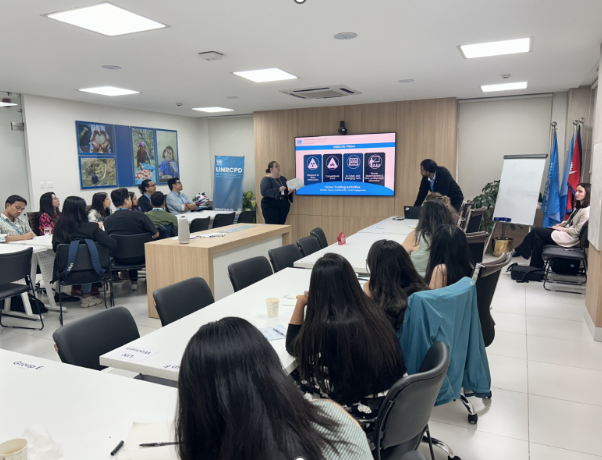
The presentation also showcased a selection of UNRCPD's recent programmes and activities. These included the Small Arms and Light Weapons Fellowship held in Jabalpur, India in March 2026 (read more); the Youth Multimedia Arts Competition (read more) in Bangkok, organized to mark the 30th anniversary of Southeast Asia Nuclear Weapon Free Zone Treaty; and a regional briefing on information and communication technologies and artificial intelligence in the military domain in September 2025 (read more). The presentation not only invited the audience to learn more about the work of UNRCPD and to access additional learning resources through the Disarmament Education Dashboard (learn more), but it also laid the foundation for the activities planned for the rest of the event.
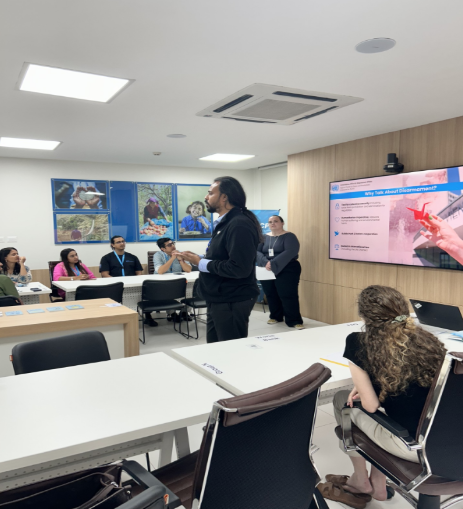
Transitioning from the presentation, Ms. Tejaswi Lal, Public Affairs intern at UNRCPD, invited the audience to participate in ‘Mapping Mandates’ a simulation exercise to help identify an unexplored or underutilized area of cooperation between their individual agencies and UNRCPD. With 9 United Nations agencies across Nepal represented through young people, synergies between disarmament, peace, and security mandates and the diverse thematic portfolios of other entities were uncovered.
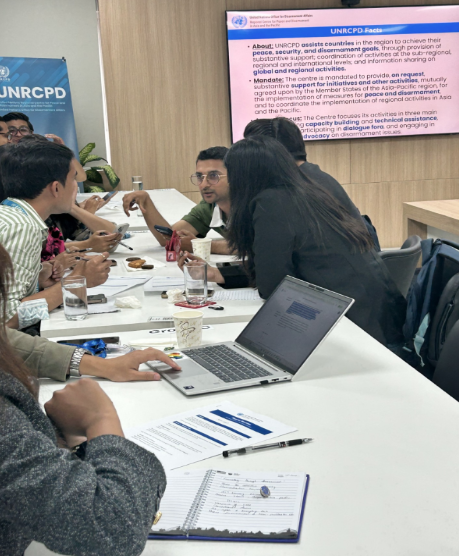
Young professionals from UN-Habitat, UNDP, UNOPS, UNODC, IFAD, UNESCO, UN Women, UNFPA, and the World Bank were grouped by agency and tasked with developing inter-agency cooperation concepts through a three-phase process: first, a mandate scan to map existing cooperation, potential areas, barriers, and entry points; second, the development of a cooperation concept addressing a specific gap or overlap and proposing a concrete initiative; and finally, a two-minute pitch to present their concepts to the room. Using the information shared with them during the presentation, fresh ideas were developed, new connections were made, and a room full of young professionals carried the knowledge that disarmament affects everyone and thus, should matter to everyone.
Strong common overlap areas were identified. Youth appeared as a shared audience for UNESCO, UNFPA, UNOPS, and UNDP. Local communities and border areas were central to proposals from UNFPA, the World Bank, IFAD, and UN‑Habitat. Livelihoods and alternatives to violence emerged as a powerful entry point, with both the World Bank and IFAD proposing skills training and financial literacy as violence prevention tools. The most concrete and novel initiatives included UNFPA’s proposal to train health volunteers on weapons smuggling, UNESCO’s arts based and information integrity campaigns, and the World Bank’s focus on ex‑combatants.
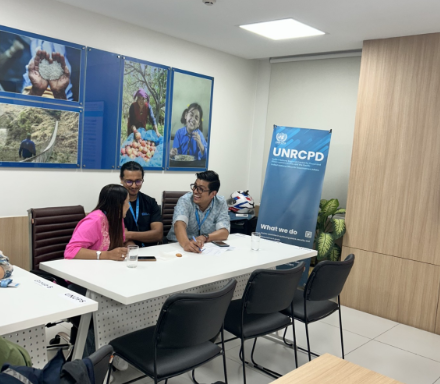
Beyond the concepts themselves, the exercise broke down silos: young professionals who had never worked together left with shared language, shared goals, and each other's contact details. The exercise demonstrated that when young professionals are given the space and structure to collaborate, the result is not just good ideas — it is the foundation of a more connected, more effective UN system.
As the afternoon progressed, the energy of the room reached new heights with the commencement of the trivia segment. 20 questions, 20 minutes, 1 winner.
With the audience being grouped randomly to encourage inter-agency teamwork, buzzers being activated for the fastest fingers first, and exciting prizes being announced; the activity officially began.
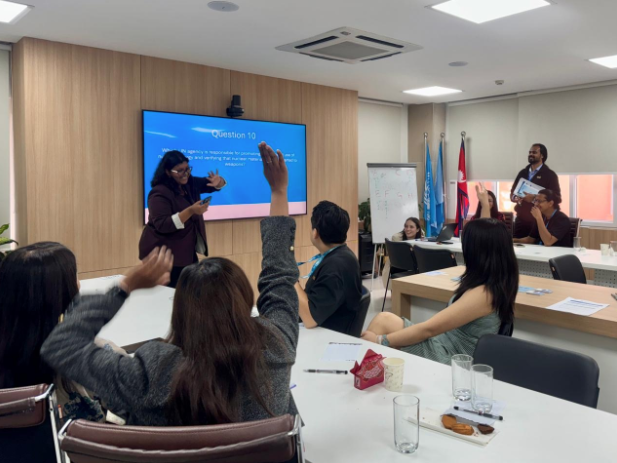
Ms. Lal took the floor as quizmaster, firing questions that blended pop culture with disarmament treaties and UN resolutions — proof that multilateral diplomacy can hold its own against a good music round. With just five seconds between the reading of each question and the first buzzer, there was no room for hesitation.
The activity, laced with healthy competition and frantic buzzing, ended with Ms. Correa being invited to present the winning team with the prizes, which consisted of exciting UNRCPD merch, including postcards of some of the artworks from the Youth Multimedia Arts Competition (read more).
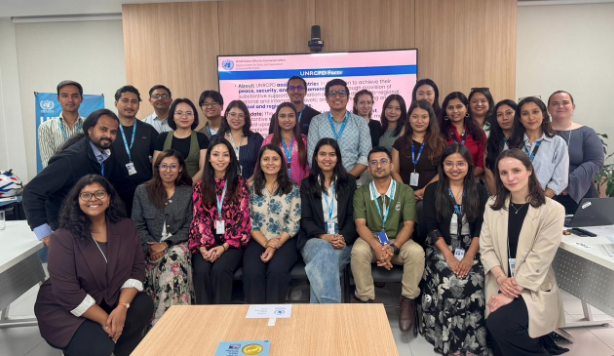
As the event drew to a close, one thing was clear. When young professionals are given the right space, the right structure, and the right questions — whether in a simulation exercise or a trivia round — they rise to the occasion. The afternoon generated not just goodwill but concrete cooperation concepts, new cross-agency relationships, and a deeper collective understanding of how disarmament intersects with every corner of the UN's work in Nepal.
Connecting through Disarmament' was more than a networking event — it was a reminder that the UN system is stronger when its people know each other. UNRCPD remains committed to building that community, one conversation at a time.
UNRCPD hopes that the event format can serve as a replicable model for other UN agencies and offices in Nepal. The Centre also encourages UN agencies to consider hosting similar Young Professional-led learning and networking initiatives, which provide platforms for strengthening inter-agency collaboration, fostering deeper and mutual understanding of mandates, and identifying new opportunities across the UN system.
For more information, contact unrcpd-info@un.org.