"Now I have become death. The destroyer of worlds"
This quote, attributed to the renowned nuclear scientist J. Robert Oppenheimer, remains one of the most haunting knells on human destructive power—and its weight endured — to this day. Although the world has already lived through the horrors of the nuclear bomb, a new kind of tool has emerged in recent years that, if misused, carries the potential for equally catastrophic consequences: Artificial Intelligence (AI).
AI has been rapidly transforming education, economies, and societies worldwide. At the same time, growing attention is being paid to the inequality of access to this technology, its implications for international peace and security, and the lack of laws and regulations guiding the development of AI.
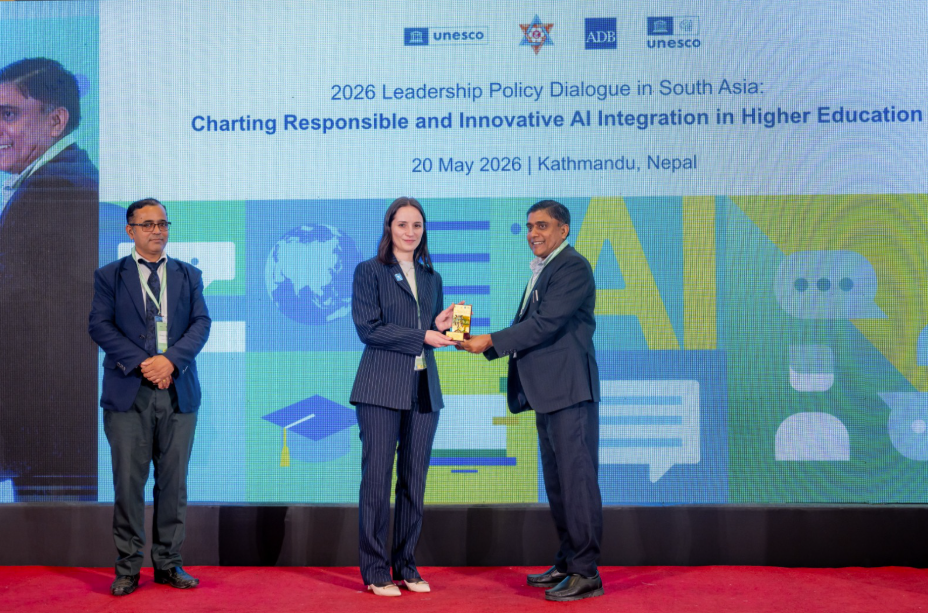
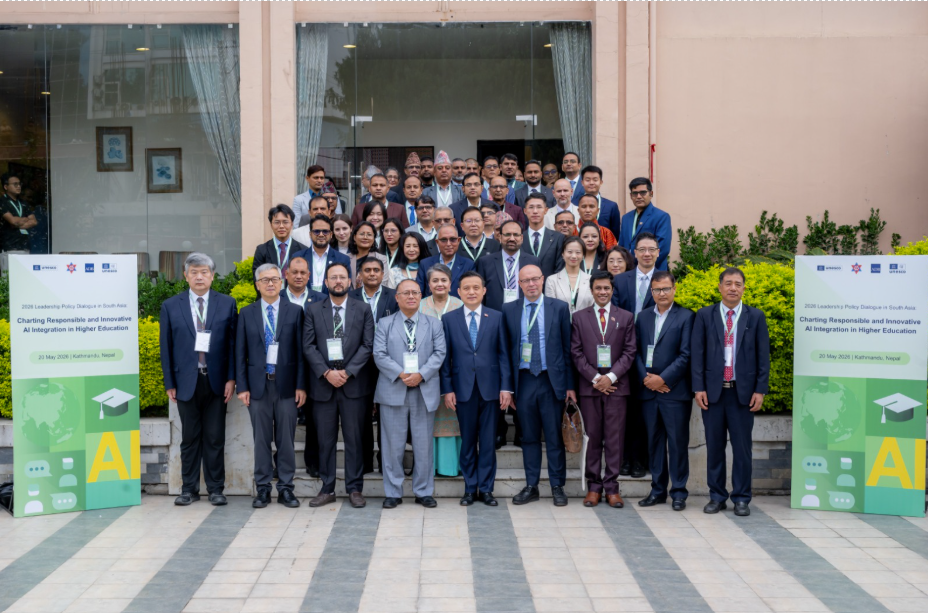
In that context, the United Nations Regional Centre for Peace and Disarmament in Asia and the Pacific (UNRCPD) was invited to speak at the 2026 Leadership Policy Dialogue in South Asia (read more), the theme for which was: Charting Responsible and Innovative AI Integration in Higher education. Jointly hosted by the UNESCO Kathmandu Office, Tribhuvan University, the Asian Development Bank (ADB), and the International Centre for Higher Education Innovation under the auspices of UNESCO (UNESCO-ICHEI), in Kathmandu, Nepal, the conference brought together academicians, researchers, policy makers, and educational institutions to discuss the implications of artificial intelligence and the increased dependency on it.
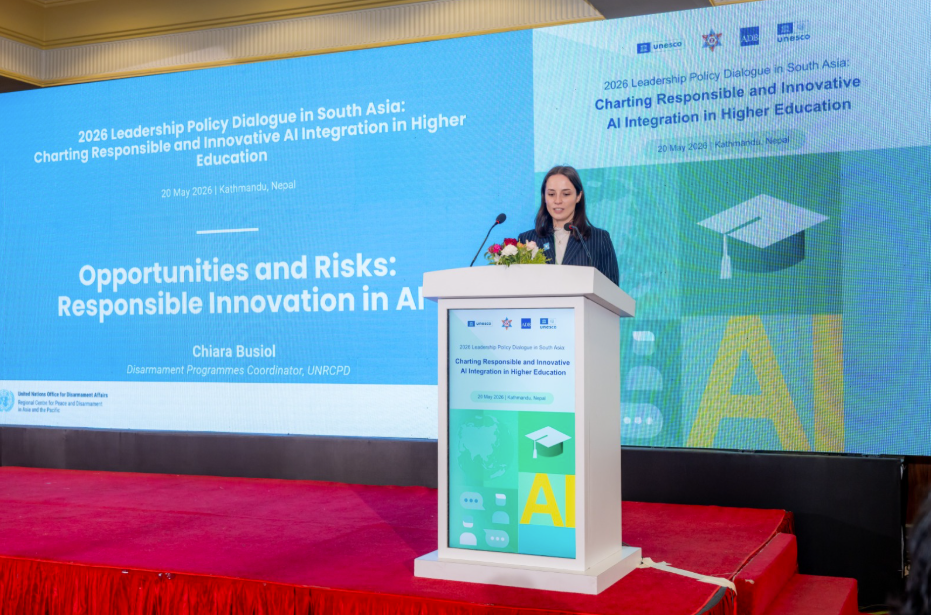
Representing UNRCPD, Ms. Chiara Busiol (Disarmament Programmes Coordinator), opened her presentation with the quote etched above. She discussed the benefits of AI, and how it has the potential to transform the lives of millions by accelerating medical breakthroughs, enhancing early warning systems for natural disasters, and bridging educational gaps in underserved communities. However, what cannot be ignored is how it is evolving to become what is known as dual-use technology. This means that the same technological advances that can help achieve the Sustainable Development Goals or transform education – can also be weaponized.
Moreover, despite rapid advances in artificial intelligence, significant technological gaps persist in ensuring that AI systems are accurate, equitable, and accountable. Access to AI tools and infrastructure remains deeply unequal, with low- and middle-income countries largely excluded from both development and governance processes. These gaps risk entrenching existing power imbalances rather than addressing them.
Militarized uses of AI, use of AI in active conflict, and using AI to spread disinformation are some of the ways it is raising increasingly threatening concerns. The message was clear – if it cannot think, feel, or reason, it should not be given the power to take a human life. The presentation highlighted the importance of maintaining meaningful human control over decisions involving the use of AI.
One of the primary issues plaguing these new advancements is the lack of regulation – a gap which is rapidly growing larger as technology advances at unprecedented rates. The UN Security Council held its first formal session to implement guardrails and formalize a structured approach to regulation in 2023. However, there is a long way to go.
This lack of regulation is an issue which not only deeply concerns the world, but finds a place of special importance in South Asia. A region housing nuclear powers, active territorial disputes, and some of the largest militaries globally; the governance gap hits particularly hard here. South Asian governments are racing ahead on AI, but their national strategies focus almost entirely on innovation and economic growth. The security dimension is largely absent from the conversation.
The stark reality is that awareness of the peace and security implications of AI remains limited. Researchers, developers, students, citizens have no idea that their work could feed into conflict, surveillance, or weapons systems, or that AI could be used to achieve these ends in the first place. The United Nations Office for Disarmament Affairs (UNODA) and the Stockholm International Peace Research Institute (SIPRI) examined this gap between education and execution (read more) and found something concerning: the education needed to understand AI's risks for peace and security is almost never taught.
In an effort to broaden the conversations around the security risks of AI and to increase the accessibility of students, educators, and citizens to these resources. The Handbook on Responsible Innovation in AI for International Peace and Security (read more) — published as UNODA Occasional Papers No. 45 in July 2025 — includes free resources such as lesson plans and accompanying model materials for capacity-building workshops. Crucially, the Handbook is built for higher education. Designed for AI educators, students, and practitioners, it offers practical strategies to evaluate and mitigate the security risks of civilian AI research. Beyond the handbook, the resource hub offers fact sheets, slide decks, and short animations covering everything from how AI is currently governed to practical standards for responsible innovation.
Universities, civil society, and young people are not passive recipients of this technology. They are the ones shaping it, and they are the ones who will live with the consequences of the decisions made today.
The question isn't just how we integrate AI into education or scale its benefits. The deeper question is whether the people building it will understand what they're building and what it could become. We know how this story ends when the answer is no, and history stands witness. The train of regulation is about to depart, and the decision to hop on before it is too late, lies in our hands.
As AI continues to shape societies and institutions, ensuring that future developers, researchers, educators, and policymakers understand both its opportunities and its risks will be essential. Universities, civil society organizations, and young people have an important role to play in promoting responsible innovation and contributing to discussions on the future governance of AI.
Through engaging in regional dialogues such as this, UNRCPD continues to support awareness-raising and inclusive discussions on the implications of emerging technologies for international peace and security.
Learn more
Handbook on Responsible Innovation in AI for International Peace and Security – including lesson plans (UNODA Occasional Papers No. 45, July 2025)
AI and peace and security
Additional resources on responsible AI and peace and security
For more information, contact unrcpd-info@un.org.