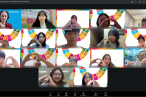
Across Asia and the Pacific, young people are acting for peace: volunteering with local organizations, participating in youth forums and shaping policy conversations that affect their future.
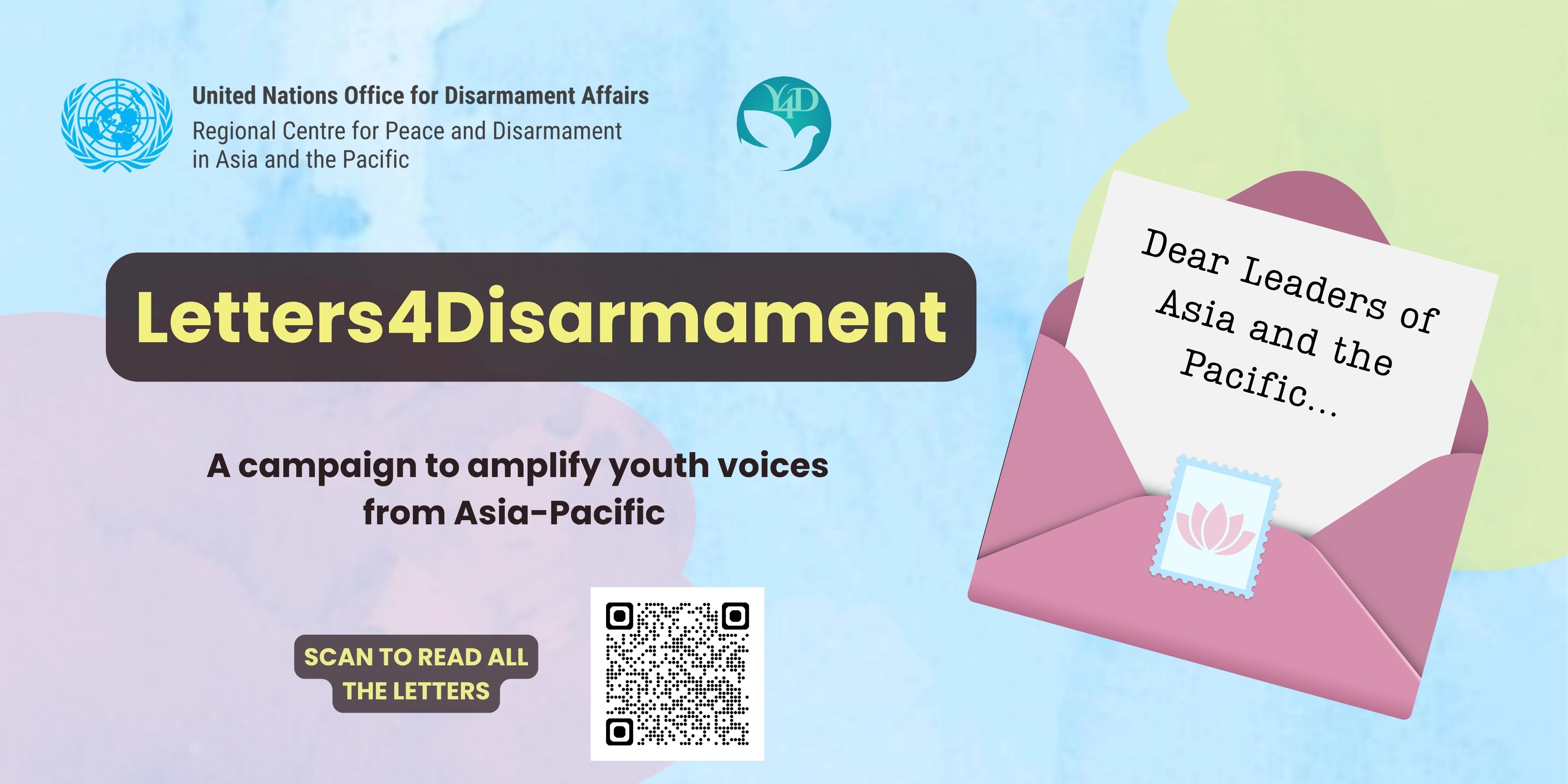
To mark International Youth Day on 12 August 2026, the United Nations Office for Disarmament Affairs' Asia-Pacific Regional Centre (UNRCPD) launched Letters4Disarmament #AsiaPacificYouth, a regional digital campaign inviting young people across the region to write a letter addressed to the political leaders of Asia and the Pacific. Each letter captures a disarmament issue that matters to its author, the peaceful future they envision, and one concrete action they personally commit to taking this year to help build it.
From Kazakhstan to Nepal to Papua New Guinea, the response was a resounding one. The 70+ letters received revealed a generation eager to contribute to peace and security discussions, and a generation full of ideas about what a safer, more peaceful Asia-Pacific could look like.
Read individually, each letter is a window into a life shaped by a particular place and history. Read together, they reveal something more: an unwavering belief that young people are not just beneficiaries of peace, but its architects.
Young people’s vision for peace
The dominant message, repeated in letter after letter, was a rejection of the idea that peace simply means the absence of armed conflict or violence. Instead, young writers described peace as something made up of a combination of factors: safety, dignity, inclusion, justice, opportunity and trust.
For many contributors, peace wasn’t an abstract diplomatic concept, but something that begins in classrooms, neighborhoods and everyday interactions. One young writer from Pakistan captured this by saying:
"Every child deserves to grow up in a community where they feel safe, where classrooms are places of hope instead of fear, and where differences are solved through dialogue rather than violence."
A call to recognize youth as partners in peacebuilding
Another clear message across the submissions was a call to be taken seriously as stakeholders in peacebuilding, not as future leaders waiting for their turn, but as present-day partners and actors already doing the work. Young writers described organizing workshops, leading community dialogues, running peer education sessions, and launching awareness campaigns in their own neighborhoods as their International Youth Day pledges.
Many letters also focused on violence closest to home, such as the spread of illegal weapons, crime, and the challenges faced by communities in boarder areas. Alongside these recurrent challenges, a newer and prominent concern surfaced: the digital world. The writers raised alarms about online hate, cyberbullying, disinformation, digital radicalization and even AI-enabled threats — from an Indonesian writer describing the online harassment of women, to a Pakistani lab professional mentioning cyberbiosecurity risks, to a submission from Nepal highlighting the challenges of AI and its military applications.
A young generation’s roadmap leading to a safer future
Another recurring theme in the letters was skepticism towards security built on military strength alone. Several young writers pushed for a redefinition of what safety actually means:
"I imagine an Asia-Pacific where security is measured not only by military strength, but by whether children feel safe, communities trust one another, and young people can disagree without fear. In that future, weapons are less visible, dialogue is stronger, and peace education becomes part of how we grow up."
UNRCPD extends its gratitude to every young person who took the time to put their vision into words. Their letters now stand as a reminder that the work of peace belongs to everyone, starting today.
Read all the letters by clicking this link.
The views expressed in this collection of letters are those of their authors and do not necessarily reflect those of the United Nations or its Member States.
To learn more about Youth4Disarmament visit Home | Youth 4 Disarmament
For more information, contact unrcpd-info@un.org.