“My key takeaway is that disarmament is not only about weapons reduction; it is also closely connected to human rights, peace, development, protection, and inclusive decision-making,” wrote Bishwamitra Bhitrakoti, a communications officer at the National Federation of the Deaf Nepal. This reflection captured a theme running through the Disarmament Toolkit 2026: how decisions about weapons and security affect people's lives, and how everyone can contribute to peace.
The fifth edition attracted more than 1,100 registrations from 106 countries. Students and youth advocates signed up alongside researchers, educators, government professionals and civil society to explore issues often seen as too technical. More than half of the registrants were women, and most were aged 18–34. Although focused on Asia and the Pacific, the Toolkit also drew interest from Africa, Europe, the Americas and Oceania.
Held online on 8–10 and 15–17 September 2026, the free online course made space for conversations about weapons, power and peace, as well as practical ways to get involved. The Toolkit was organized by United Nations Office for Disarmament Affairs’ Regional Centre for Peace and Disarmament in Asia and the Pacific (UNRCPD), in collaboration with peace educator Dr. Swarna Rajagopalan of Chaitanya and with the support of Rissho Kosei-kai.
Day 1: Foundations of disarmament, gender and peacebuilding
Moderated by Ms. Racquel Gertrude Correa, Associate Programme Management Officer at UNRCPD, the opening session introduced the questions that would guide the course. In his opening remarks, Mr. Deepayan Basu Ray, Director of UNRCPD, emphasized that disarmament concerns people's dignity, safety and opportunities for dialogue. He encouraged participants to consider what security means for individuals and societies.
An introduction to the United Nations disarmament agenda provided a starting point for exploring these questions. Ms. Correa explained the role of UNODA and its regional centre for Asia and the Pacific, UNRCPD, connecting disarmament, non-proliferation and arms control with efforts to reduce humanitarian harm, prevent escalation and protect resources for development.
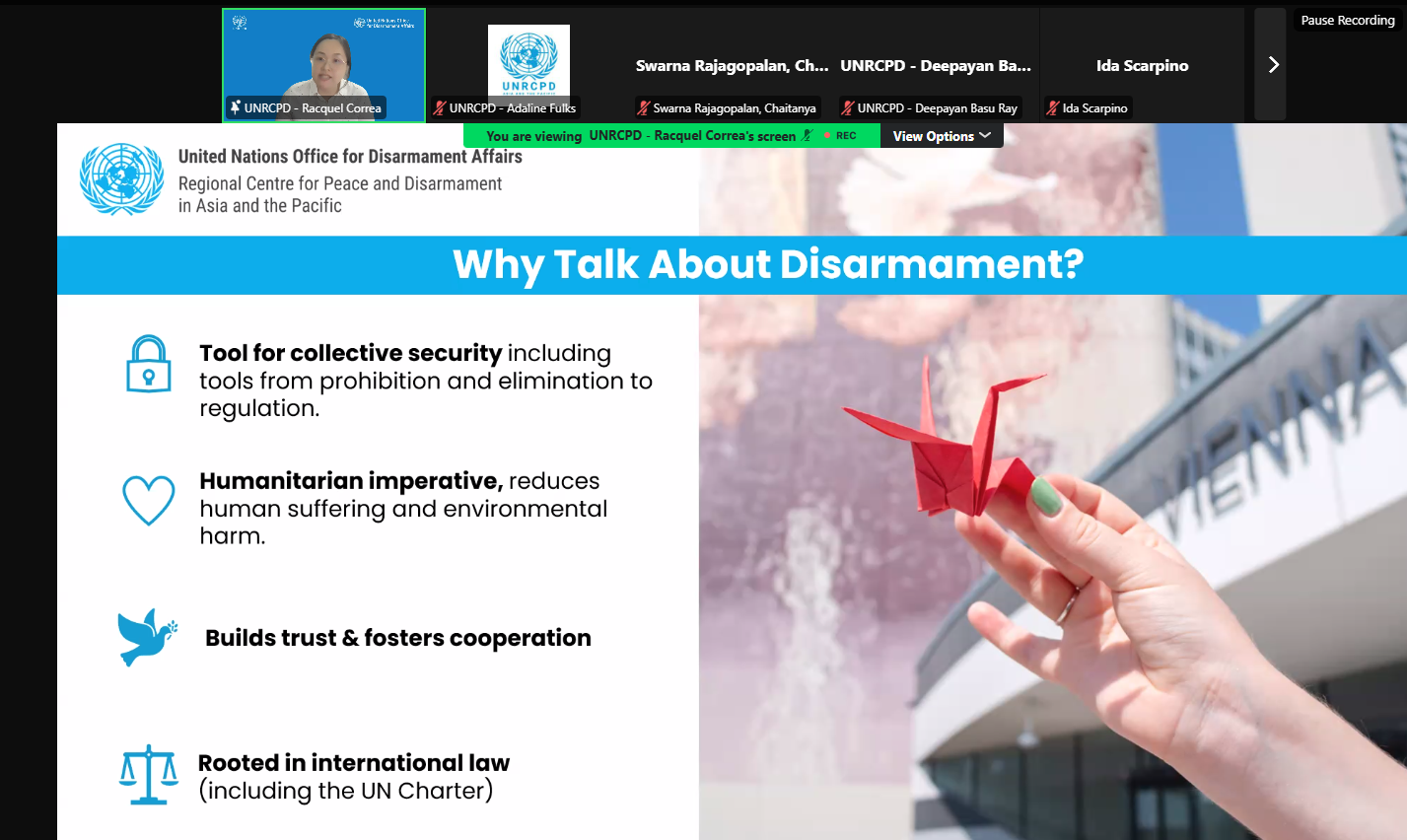
Ms. Racquel Gertrude Correa, Associate Programme Management Officer at UNRCPD, presenting on the foundations of disarmament
The discussion then turned to whose security is considered and whose experiences are overlooked. Dr. Swarna Rajagopalan brought a gender lens to peace and security, examining power and participation in decision-making. She connected the Women, Peace and Security agenda with a broader understanding of peace that includes equality, justice and human dignity.
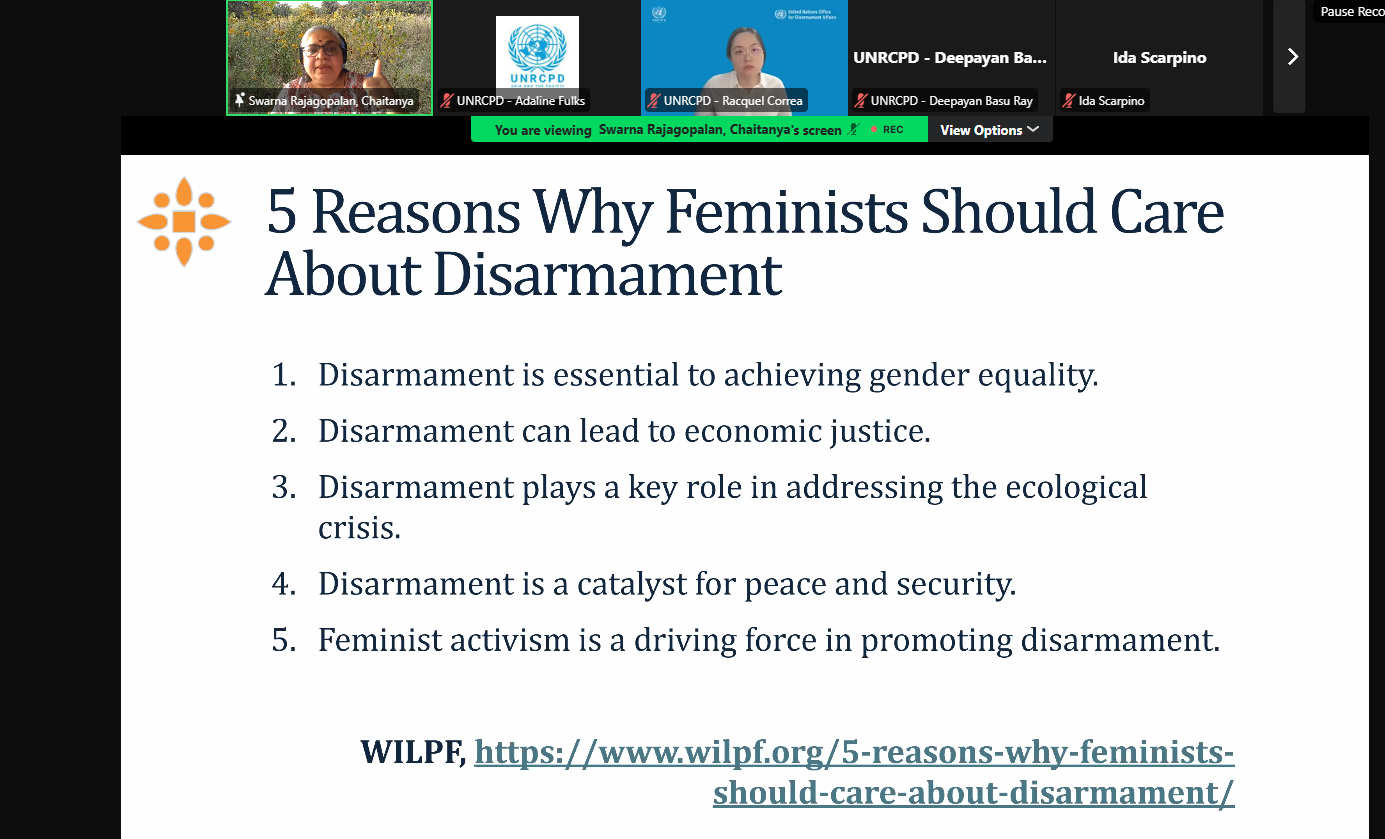
Dr. Swarna Rajagopalan of Chaitanya, presenting on feminist perspectives in disarmament and the connections between disarmament and gender equality
The gendered consequences of small arms were explored by Ms. Bianca Pabotoy, Programme Officer at the International Action Network on Small Arms (IANSA). Addressing domestic and conflict-related violence, she highlighted the importance of gender-responsive policies, stronger data and cooperation between arms control and women's organizations.
Women's roles in armed groups added another perspective. Dr. Júlia Palik, Senior Researcher at the Peace Research Institute Oslo (PRIO), discussed their exclusion from disarmament, demobilization and reintegration (DDR) processes. Her contribution showed why peace negotiations and reintegration programmes need to recognize women as combatants, leaders and participants with distinct experiences and needs.
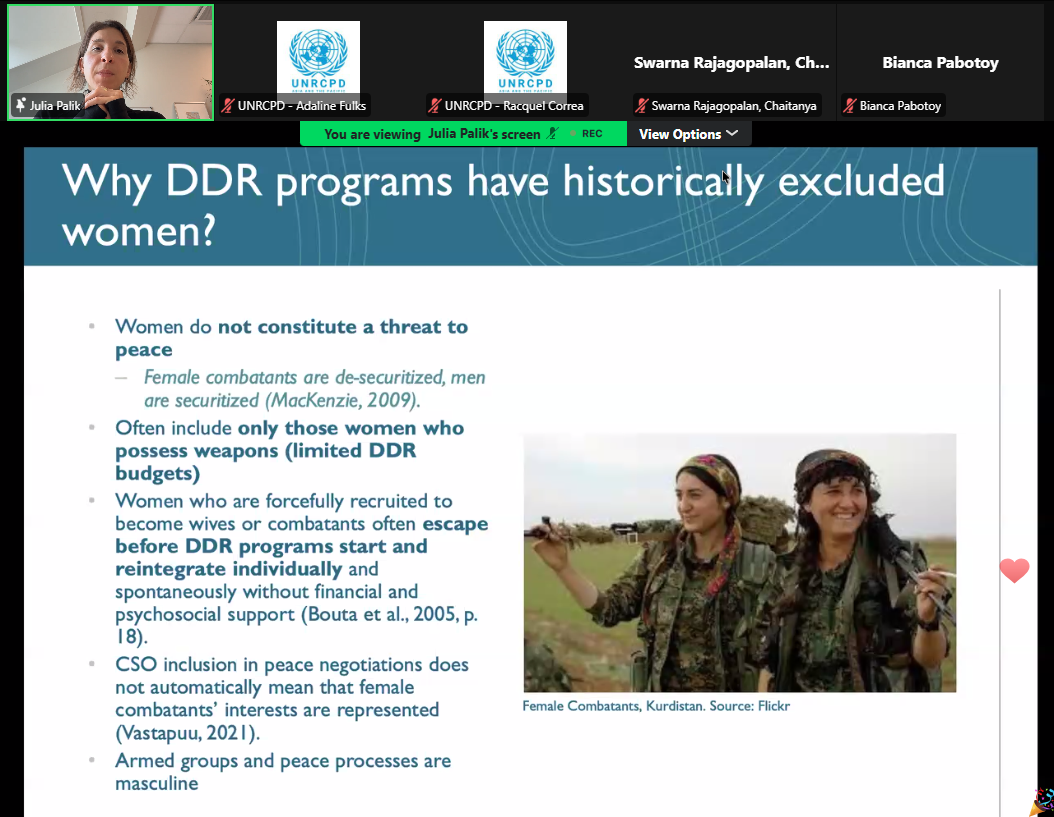
Dr. Júlia Palik, Senior Researcher at the Peace Research Institute Oslo (PRIO), presenting on women’s inclusion in disarmament, demobilization and reintegration processes
Day 2: Conventional weapons and armed violence
The second session, moderated by Mr. Deepayan Basu Ray, focused on conventional weapons and the systems intended to prevent diversion and reduce armed violence. Discussions linked international instruments with responsibilities at institutional, national and local levels.
Following a weapon through its lifecycle, Ms. Ida Scarpino explained the risks that arise from manufacture and transfer to stockpiling, possession and disposal. She introduced instruments addressing small arms, tracing, arms transfers and ammunition management, highlighting the need for a comprehensive approach at every stage and the connections between arms control and development.
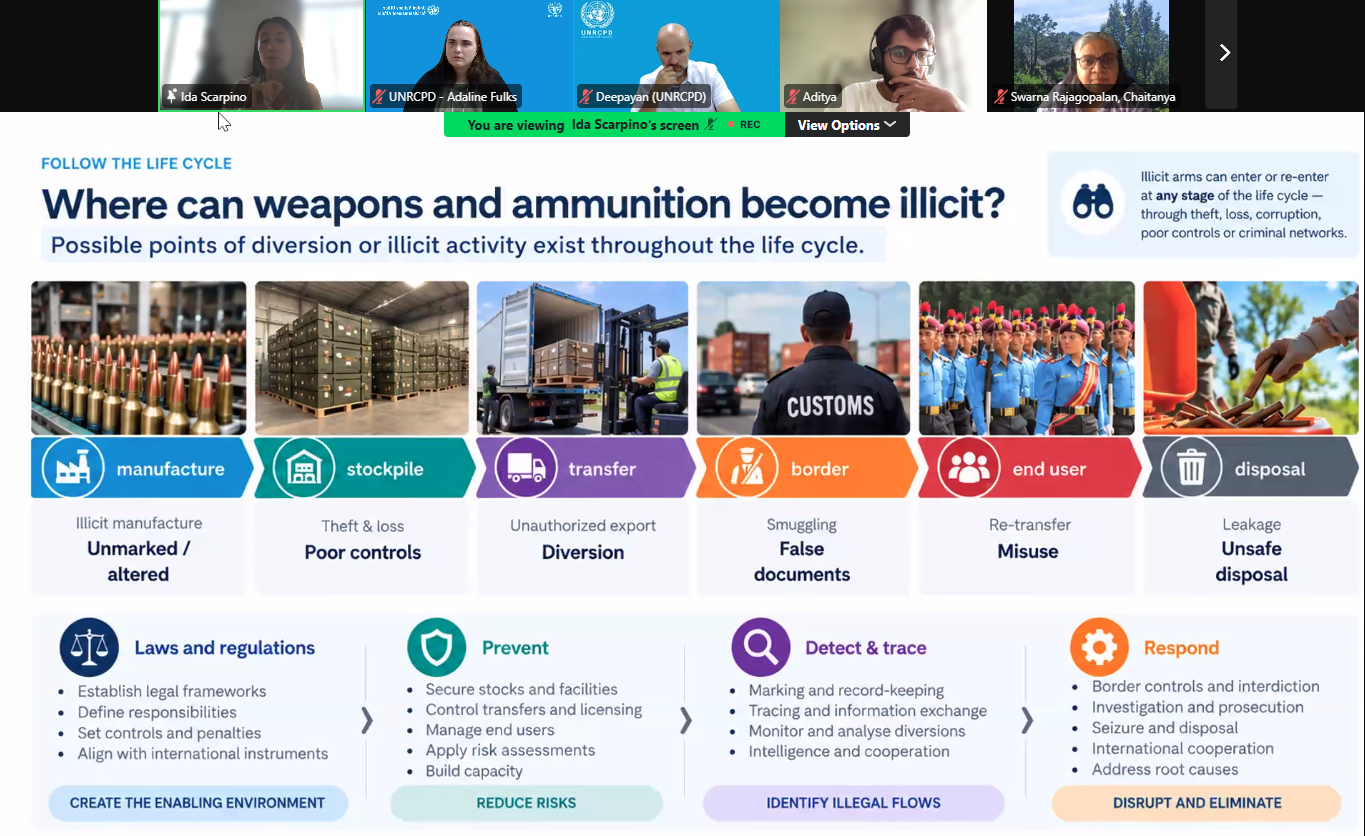
Ms. Ida Scarpino presenting on weapons and ammunition diversion risks across the lifecycle of conventional weapons
The dangers that remain after fighting ends came into focus through humanitarian mine action. Mr. Llewelyn Jones of Mines Advisory Group (MAG) described clearance, risk education, victim assistance, stockpile destruction and advocacy. His presentation also addressed weapons and ammunition management, drawing attention to the importance of safe, secure stockpiles.
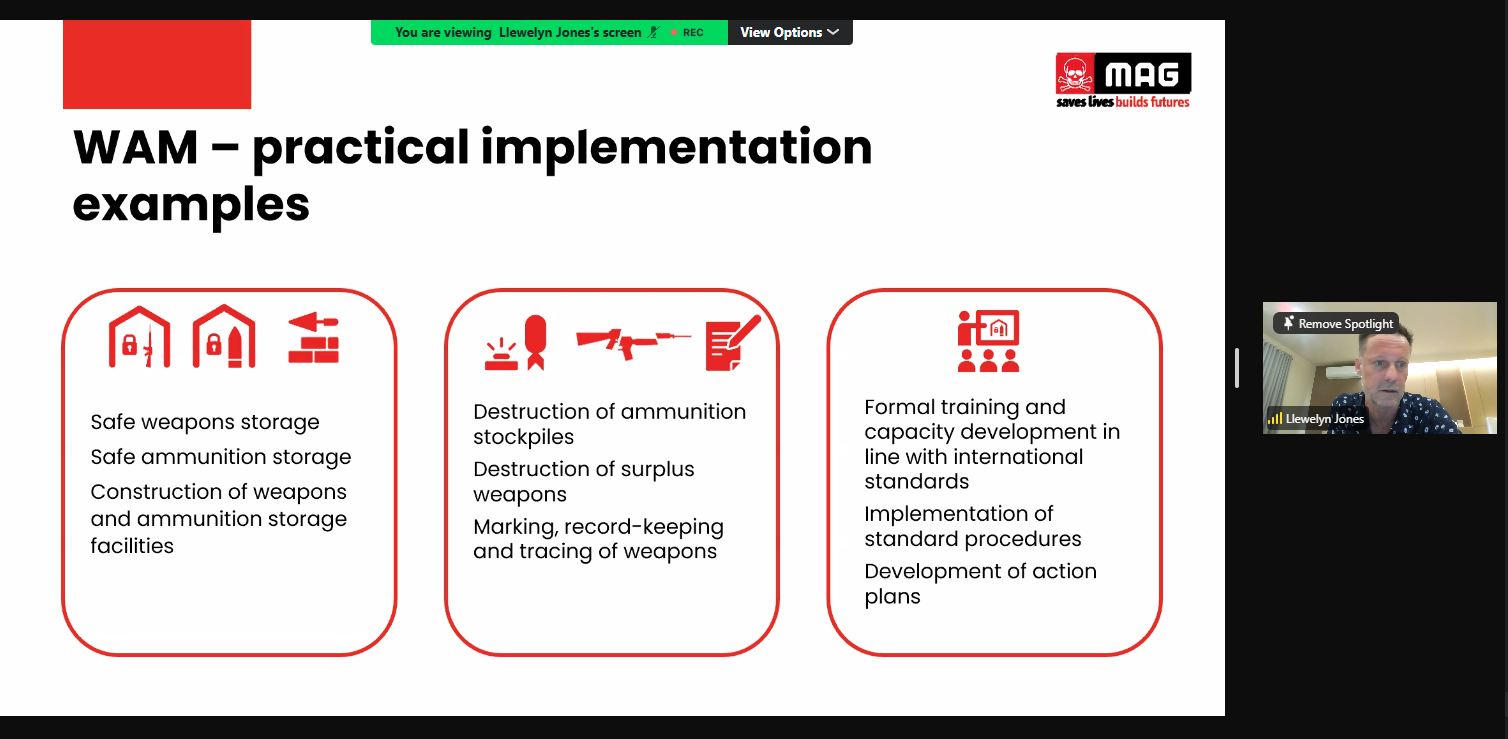
Mr. Llewelyn Jones of Mines Advisory Group (MAG), presenting practical approaches to weapons and ammunition management
The legal discussion explored how international humanitarian law balances military necessity and humanity. Dr. Andrey Kozik, Regional Legal Advisor for South Asia at the International Committee of the Red Cross (ICRC), highlighted restrictions on means and methods of warfare and the role of the Convention on Certain Conventional Weapons in addressing humanitarian consequences.
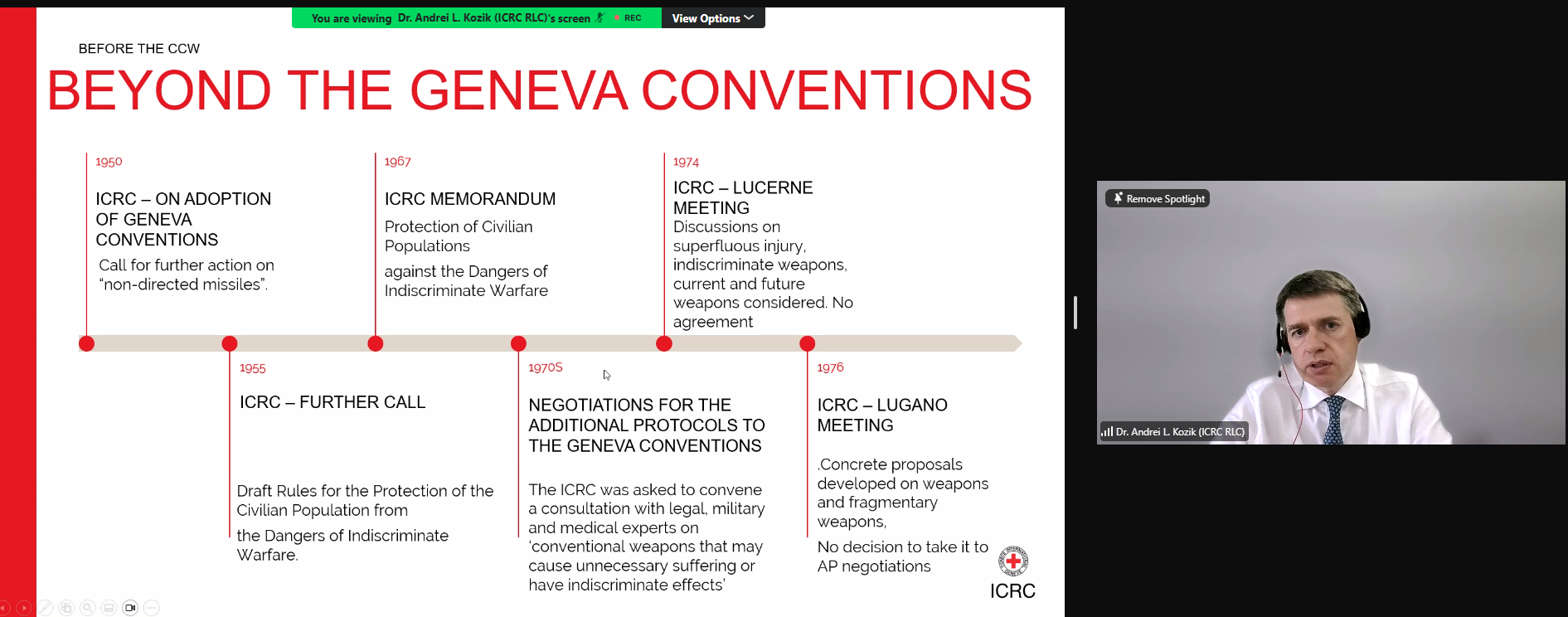
Dr. Andrey Kozik, Regional Legal Advisor for South Asia at the International Committee of the Red Cross (ICRC), presenting on international humanitarian law and restrictions on means and methods of warfare
New technologies are also changing the challenges of conventional arms control. Mr. Rueben Ananthan Santhana Dass, Associate Research Fellow at the S. Rajaratnam School of International Studies (RSIS), explored 3D-printed firearms and drones. He discussed how online knowledge-sharing and accessible technologies are changing illicit weapons production and use, creating challenges for existing controls.
Responsibility for weapons runs through a chain of individual, institutional and local decisions. Bringing this perspective into the discussion, Ms. Rajani Thapa emphasized that responsibility extends throughout a weapon's lifecycle and that the same weapon can affect people differently. Her contribution highlighted women's participation in peacekeeping and the need to understand how people experience armed violence.
Day 3: Emerging technologies, cybersecurity and artificial intelligence
Moderated by Mr. Aaron Junhoung Yoo, Deputy Director of UNRCPD, the third session looked into how technological change affects international security and disarmament. Contributions explored the responsibilities of governments, researchers, industry and civil society in managing risks while supporting beneficial innovation.
An overview of United Nations Security Council resolution 1540 and its successor resolutions on emerging technologies set the context for the day's discussion. Ms. Amanda Cowl, UNODA's 1540 Regional Coordinator for Asia and the Pacific, explained efforts to prevent non-state actors from acquiring weapons of mass destruction. She then discussed how relevant successor resolutions address evolving proliferation risks and advances in science and technology, including the challenges that transfers of knowledge create for national controls.
Responsible innovation was the focus of Mr. René Holbach, Political Affairs Officer in UNODA's Science, Technology and International Security Unit (STU). He discussed the dual-use nature of emerging technologies and encouraged attention to ethical and security considerations throughout research and development, including the risks created when technologies converge.
Mr. Aaron Junhoung Yoo, Deputy Director of UNRCPD, moderating a discussion with Mr. René Holbach and Ms. Virginia Browning on responsible innovation and cybersecurity
Cybersecurity brought the discussion to risks affecting healthcare, infrastructure and civilian wellbeing. Ms. Virginia Browning, Programme Management Officer in UNODA's STU, explained how international governance frameworks can support responsible use of information and communications technologies (ICTs). She discussed the UN Groups of Governmental Experts (GGEs), which developed foundational cyber norms, and confidence-building measures that help States communicate, reduce misunderstandings and manage security risks.
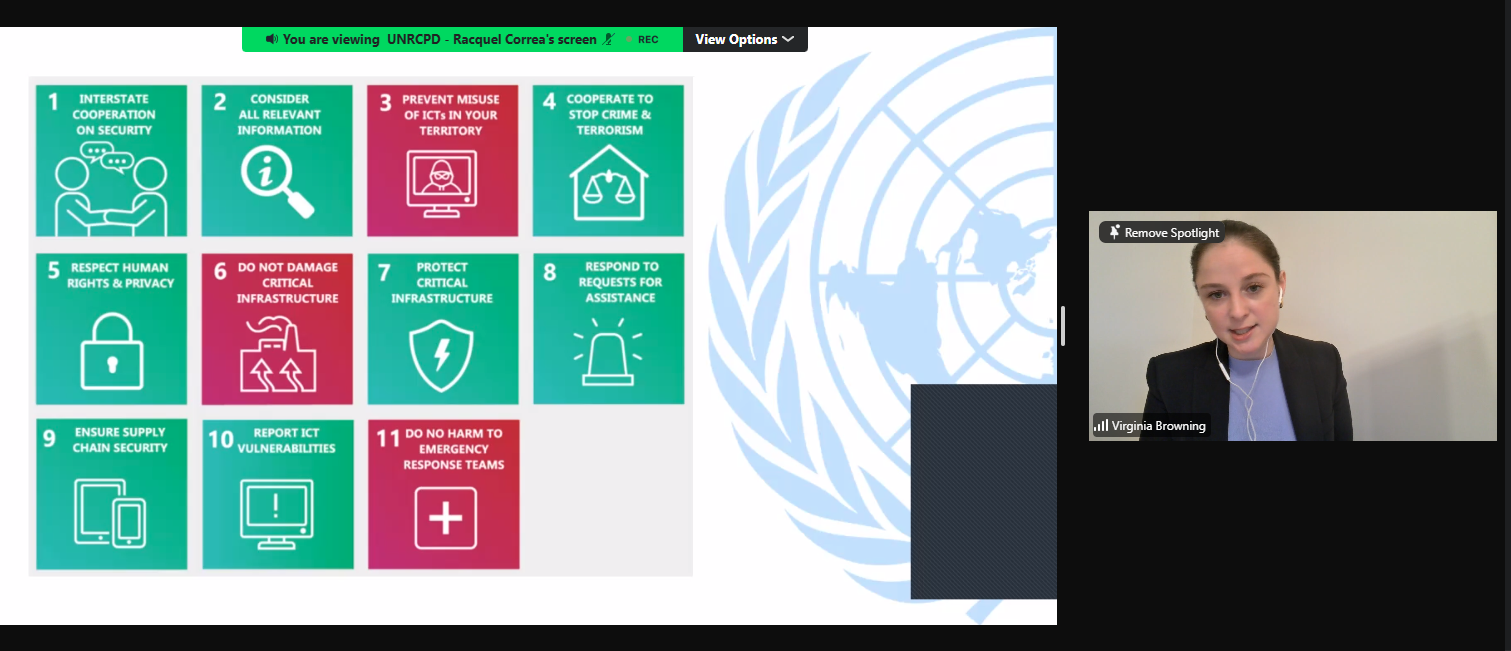
Ms. Virginia Browning, Programme Management Officer in UNODA’s Science, Technology and International Security Unit, presenting on international cyber norms and the responsible use of ICTs
An interactive 'AI or Not' exercise, facilitated by Ms. Racquel Gertrude Correa, invited participants to distinguish authentic images from AI-generated ones. The activity illustrated AI's implications for the reliability of information and public trust, connecting the broader security discussion with a challenge participants could encounter in daily life.
The military use of AI raised further questions about human judgement and accountability. Ms. Mei Ching Liu, Associate Research Fellow at RSIS, presented applications in decision-support, logistics and training, as well as autonomous weapons. She outlined governance discussions and the challenges of maintaining human responsibility and compliance with international humanitarian law.
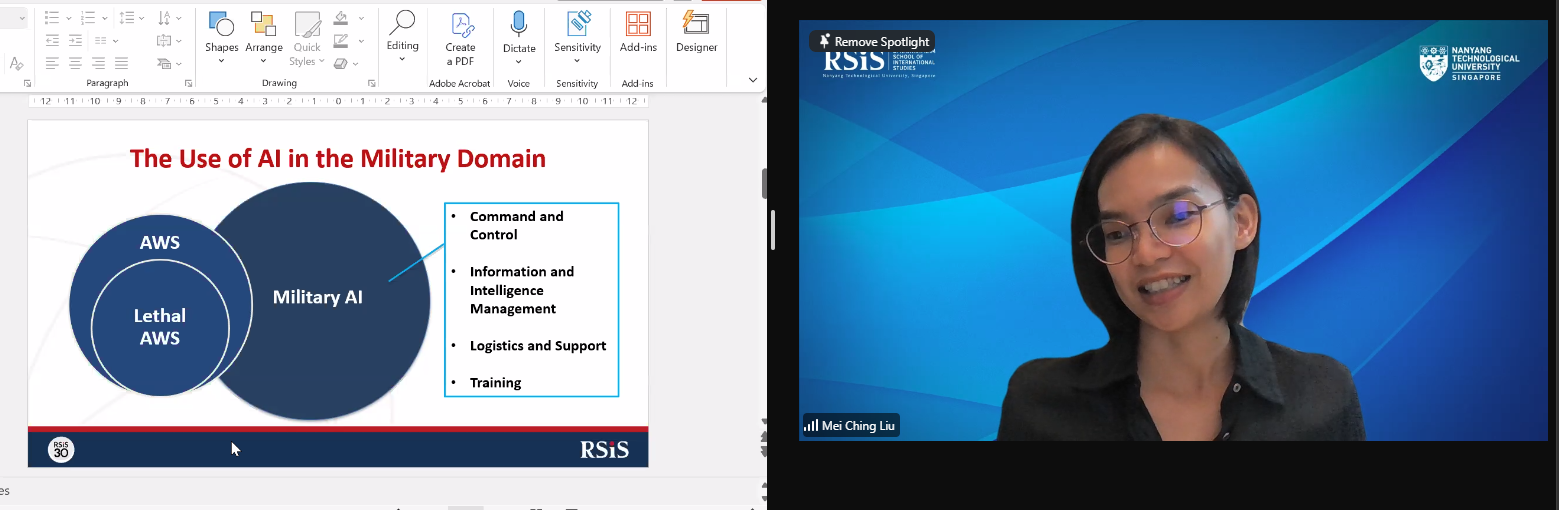
Ms. Mei Ching Liu, Associate Research Fellow at RSIS, presenting on artificial intelligence in the military domain
For Ledy Seftiana, a researcher from Indonesia (Republic of Indonesia Defense University), the discussion opened a new area of learning. She said: “This week taught me so much about defense technology and AI, both completely new to me. I'm walking away more careful about trusting what I see online, and keen to keep following how AI develops and how the international community responds to it.”
Day 4: Weapons of mass destruction, outer space and non-proliferation
The fourth session, moderated by Mr. Deepayan Basu Ray, focused on weapons of mass destruction, security in outer space and the international frameworks that address these challenges. Trust, transparency and cooperation emerged as recurring themes across the presentations.
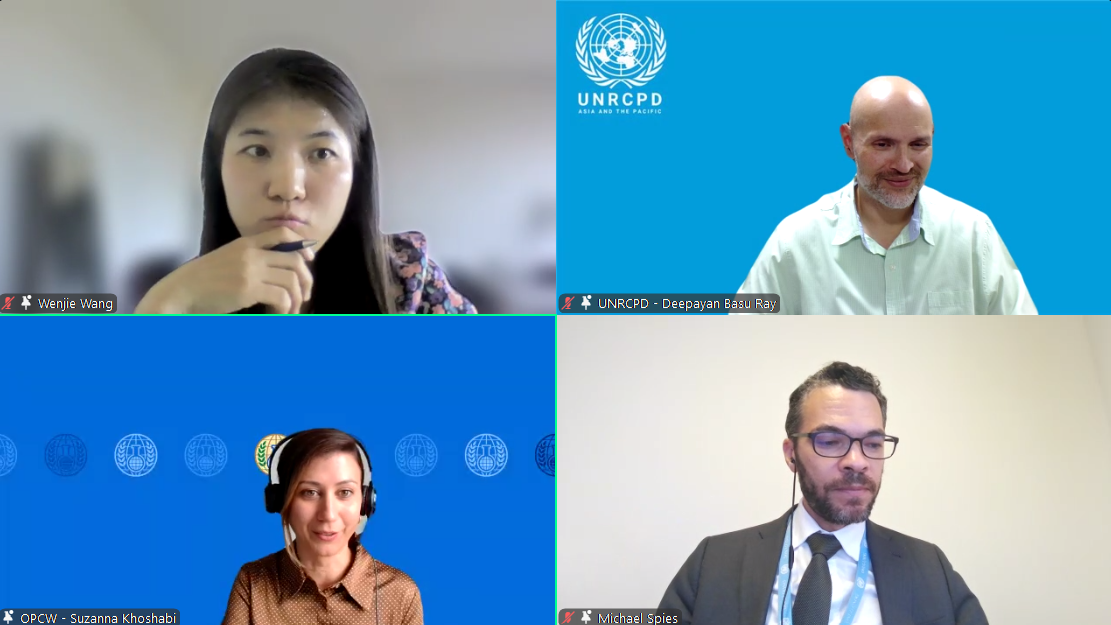
Mr. Deepayan Basu Ray, Director of UNRCPD, moderating a discussion with Ms. Wenjie Wang, Ms. Suzanna Khoshabi and Mr. Michael Spies on weapons of mass destruction and outer space security
Outer space is closely connected to life on Earth through communications, navigation, disaster response and development. Mr. Michael Spies, Deputy Chief of UNODA's Geneva Branch, discussed threats to satellites and the risks posed by orbital debris. He discussed international efforts to prevent an arms race in outer space through responsible behavior and confidence-building.
Regional cooperation came into focus through the Bangkok Treaty and the Southeast Asian Nuclear-Weapon-Free Zone. Ms. Annisa Wahidah of the ASEAN Secretariat explored ASEAN’s contributions to non-proliferation, confidence-building and peaceful nuclear cooperation, highlighting the relevance of public awareness and youth engagement to continued implementation.
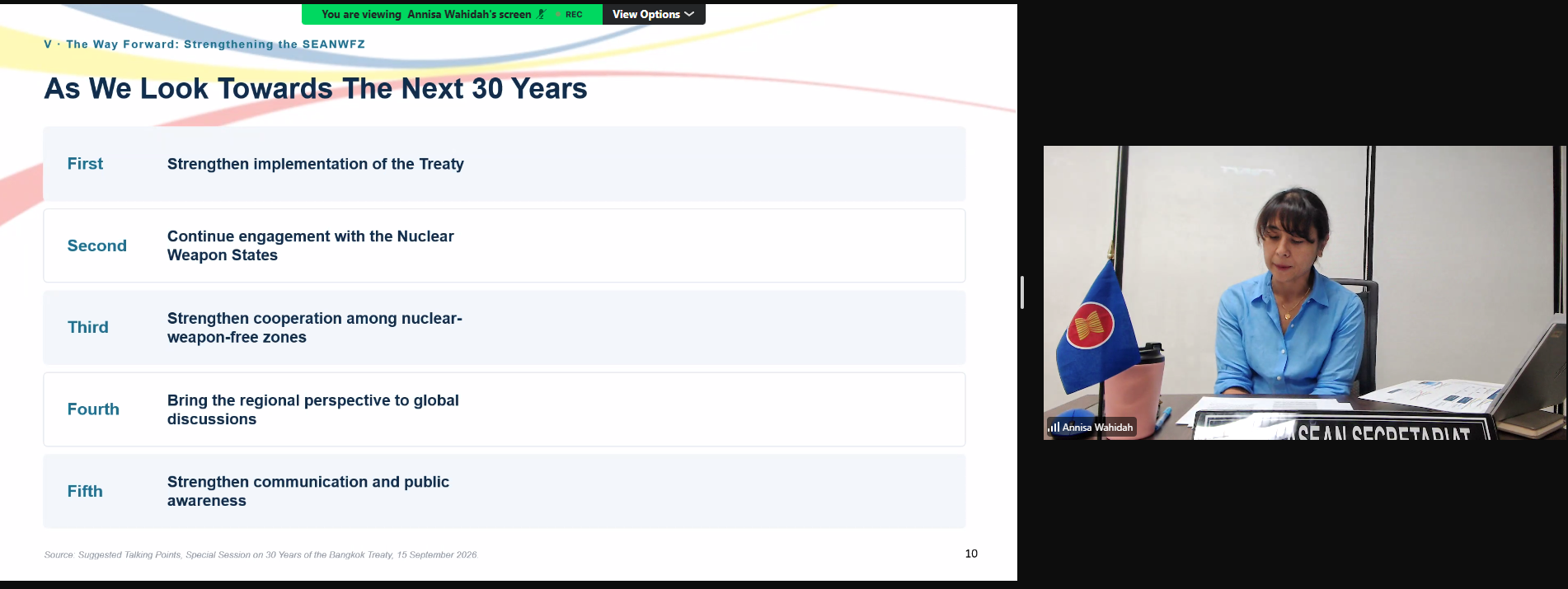
Ms. Annisa Wahidah of the ASEAN Secretariat, presenting on the Bangkok Treaty and the future of Southeast Asia’s nuclear-weapon-free zone
Turning to the global nuclear architecture, Mr. Zhandos Issayev of UNODA's Weapons of Mass Destruction Branch outlined the Treaty on the Non-Proliferation of Nuclear Weapons, nuclear-weapon-free zones and the Treaty on the Prohibition of Nuclear Weapons. His presentation considered the challenges facing multilateral cooperation and the importance of sustaining these frameworks.
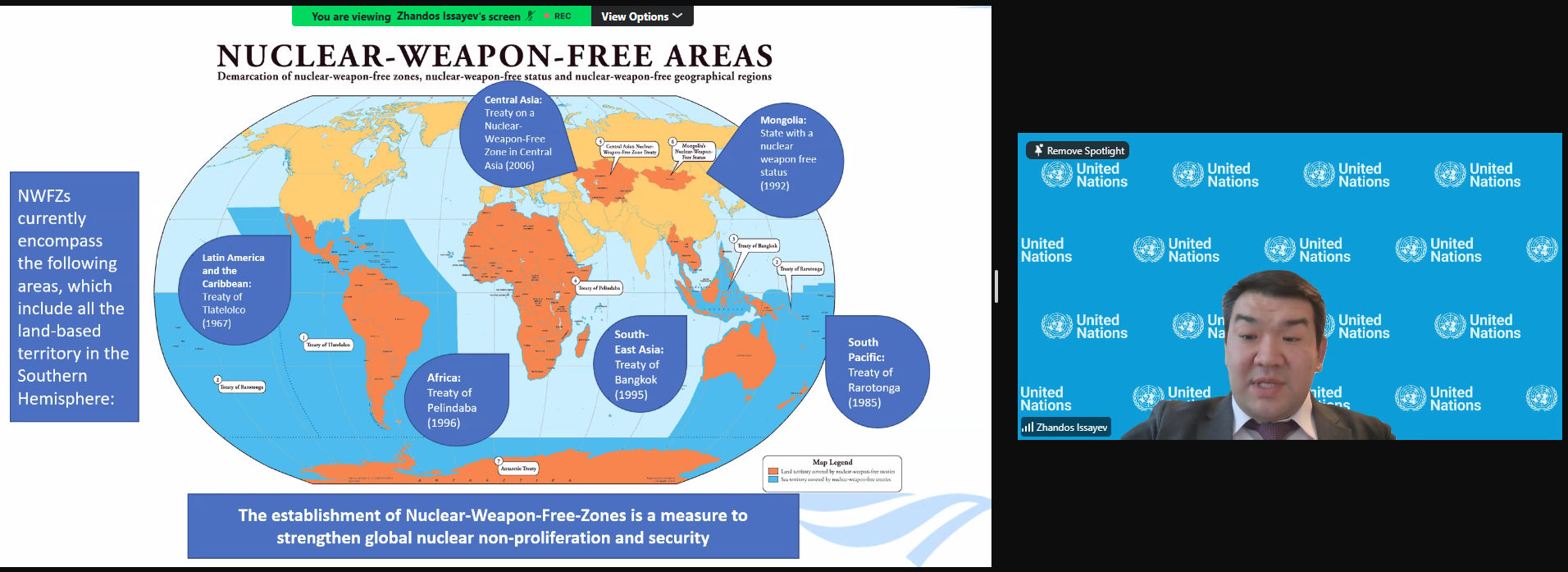
Mr. Zhandos Issayev of UNODA’s Weapons of Mass Destruction Branch, presenting on nuclear-weapon-free zones and the global nuclear disarmament and non-proliferation framework
Chemical weapons governance showed both the achievements of international cooperation and the work that remains. Ms. Suzanna Khoshabi of the Organisation for the Prohibition of Chemical Weapons (OPCW) introduced the Chemical Weapons Convention and the destruction of declared stockpiles. She emphasized that preventing re-emergence remains an ongoing task as scientific advances and dual-use chemicals create continuing risks.
Biotechnology and AI also pose questions for biological weapons governance. Ms. Wenjie Wang of the Biological Weapons Convention Implementation Support Unit (ISU) highlighted confidence-building measures, responsible science and ongoing discussions to strengthen the Convention. Questions from participants connected these frameworks with industry, emerging technologies and the challenge of building trust.
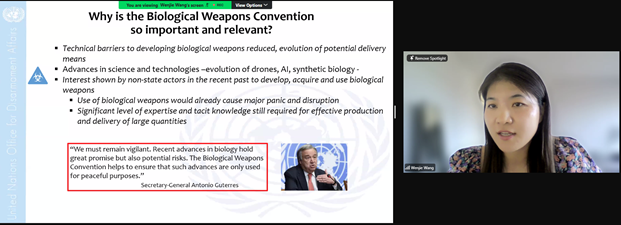
Ms. Wenjie Wang of the Biological Weapons Convention Implementation Support Unit, presenting on the Convention’s relevance and efforts to strengthen biological weapons governance
Day 5: Power, patriarchy, politics and peace
Dr. Swarna Rajagopalan moderated the fifth session, which highlighted how power relations, institutions and inequalities shape ideas of peace and security. The discussions brought people's lived experiences into debates about militarization, resources and political priorities.
In a conversation with Dr. Rajagopalan, Dr. Asha Hans, President of Sansristi, explored the relationships between the State, militarism and patriarchy. She questioned priorities that place arms spending ahead of people's welfare. Dr. Zaynab El Bernoussi, Associate Professor of Political Science at The Africa Institute, Global Studies University, highlighted dignity, citizenship and the human relationships behind institutions such as States and markets. Both contributions encouraged attention to how people themselves define security and judge progress.
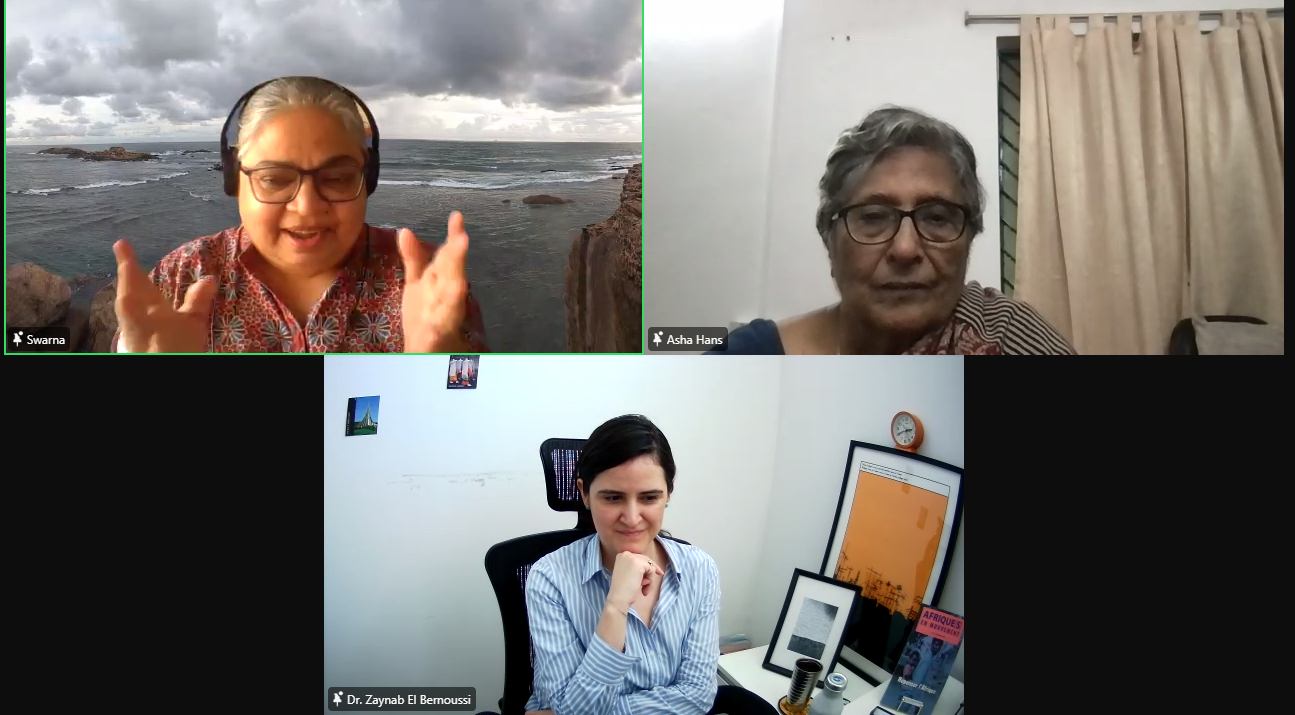
Dr. Swarna Rajagopalan in conversation with Dr. Asha Hans and Dr. Zaynab El Bernoussi on States, markets and patriarchy
Climate pressures added another dimension to these questions. Dr. Amy Dwyer, Head of Gender and Peacebuilding at Conciliation Resources, drew on research in Uganda, Pakistan-administered Kashmir and the Philippines to highlight the connections between gender, climate and conflict. She explored how climate shocks interact with existing inequalities and insecurity, emphasizing the value of integrating gender analysis into climate action and conflict prevention.
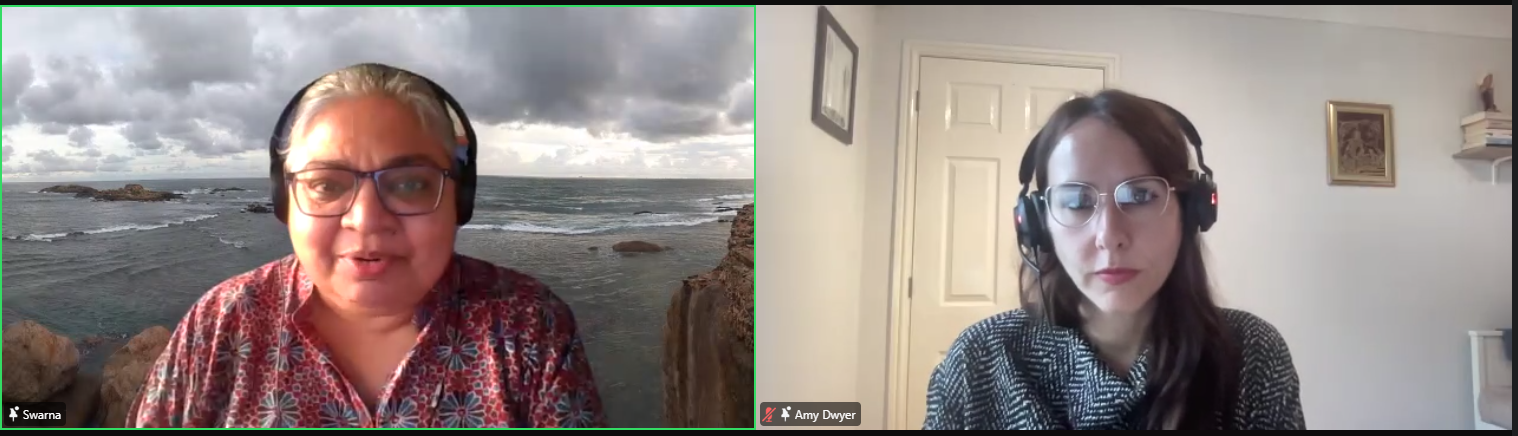
Dr. Amy Dwyer, Head of Gender and Peacebuilding at Conciliation Resources, in conversation with Dr. Swarna Rajagopalan on gender, climate and conflict
The experience of peace activism offered lessons for sustaining public engagement. Dr. Rebecca Johnson, Founding Co-Chair of the International Campaign to Abolish Nuclear Weapons (ICAN), drew on Greenham Common and encouraged participants to question nuclear deterrence. She discussed how care, emotion, art and connections with others can sustain action for peace. Participants' questions explored women's leadership, climate impacts and ways to advance disarmament dialogue.
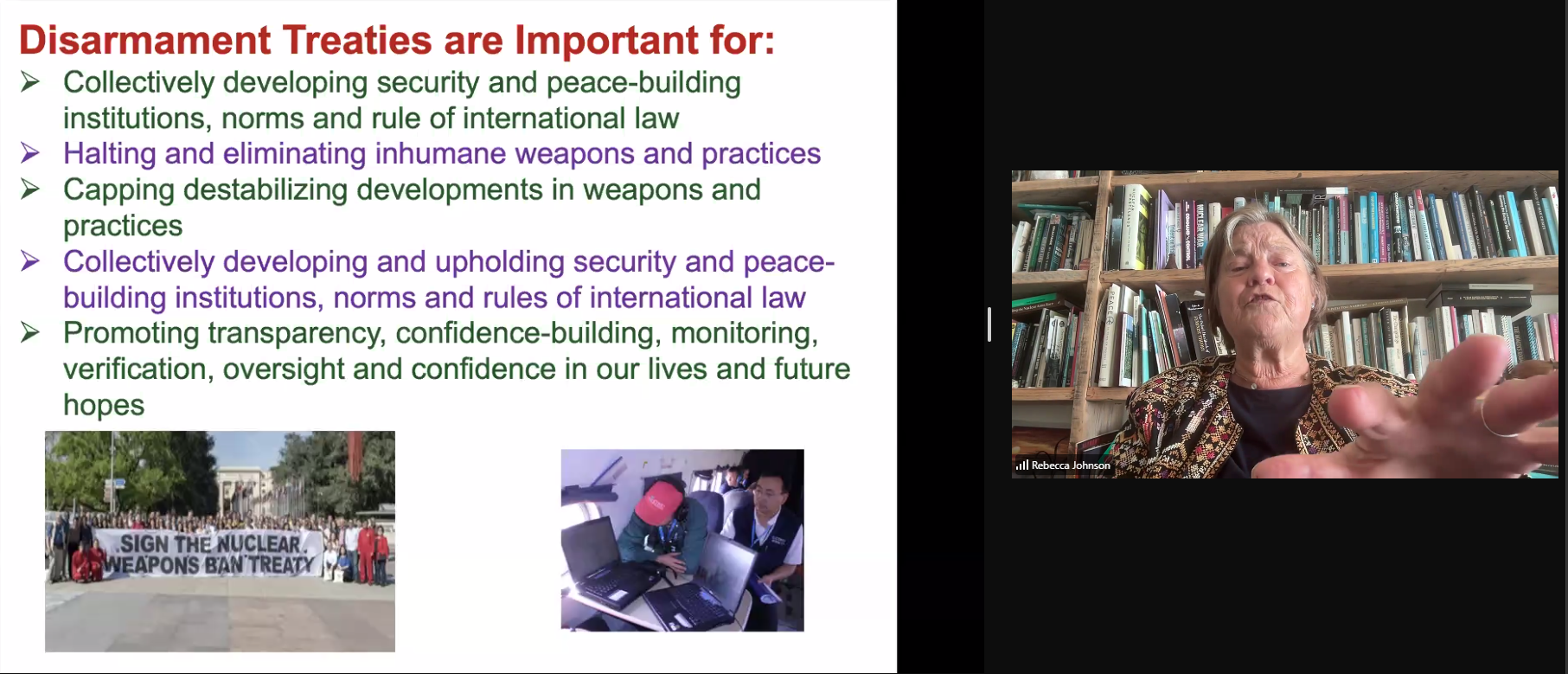
Dr. Rebecca Johnson, Founding Co-Chair of the International Campaign to Abolish Nuclear Weapons (ICAN), presenting on disarmament treaties and public engagement in nuclear disarmament
Day 6: From knowledge to action
The final day focused on disarmament education, journalism, advocacy and practical ways to contribute to disarmament. Ms. Racquel Gertrude Correa moderated the session and exchanges that connected the programme's themes with participants' own skills and interests.
Opportunities to continue learning were introduced by Ms. Veerle Moyson, Project and Research Coordinator at UNODA's Vienna Office. She presented resources including the Disarmament Education Dashboard and its online courses. Her message was that education should develop the knowledge and skills people need to participate in policymaking and public debate, including preparing young people to contribute to security discussions.
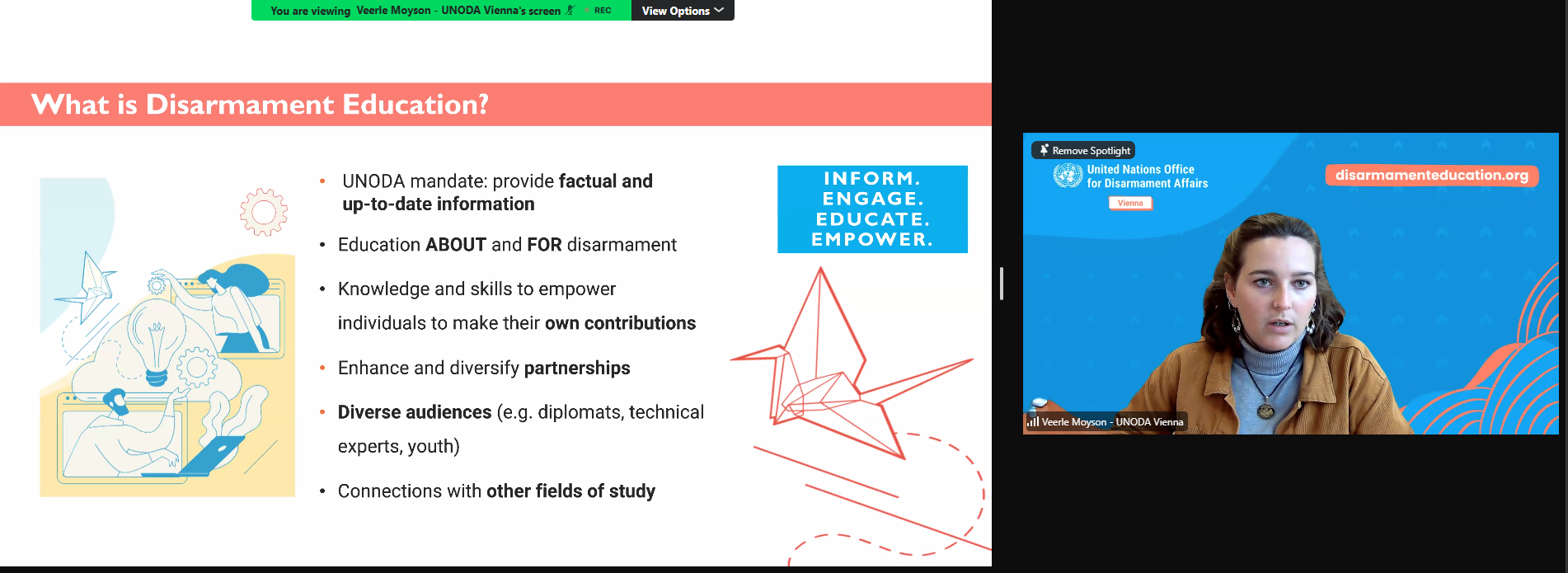
Ms. Veerle Moyson, Project and Research Coordinator at UNODA’s Vienna Office, introducing disarmament education resources and opportunities for engagement
Journalism offered a way to preserve lessons that might otherwise be lost. Ms. Yumi Kanazaki, Senior Staff Writer at Hiroshima's Chūgoku Shimbun, explored the importance of recording survivor testimony and historical evidence. She emphasized the urgency of documenting the stories of hibakusha, survivors of the atomic bombings, and the role of factual reporting in preserving memory and countering misinformation.
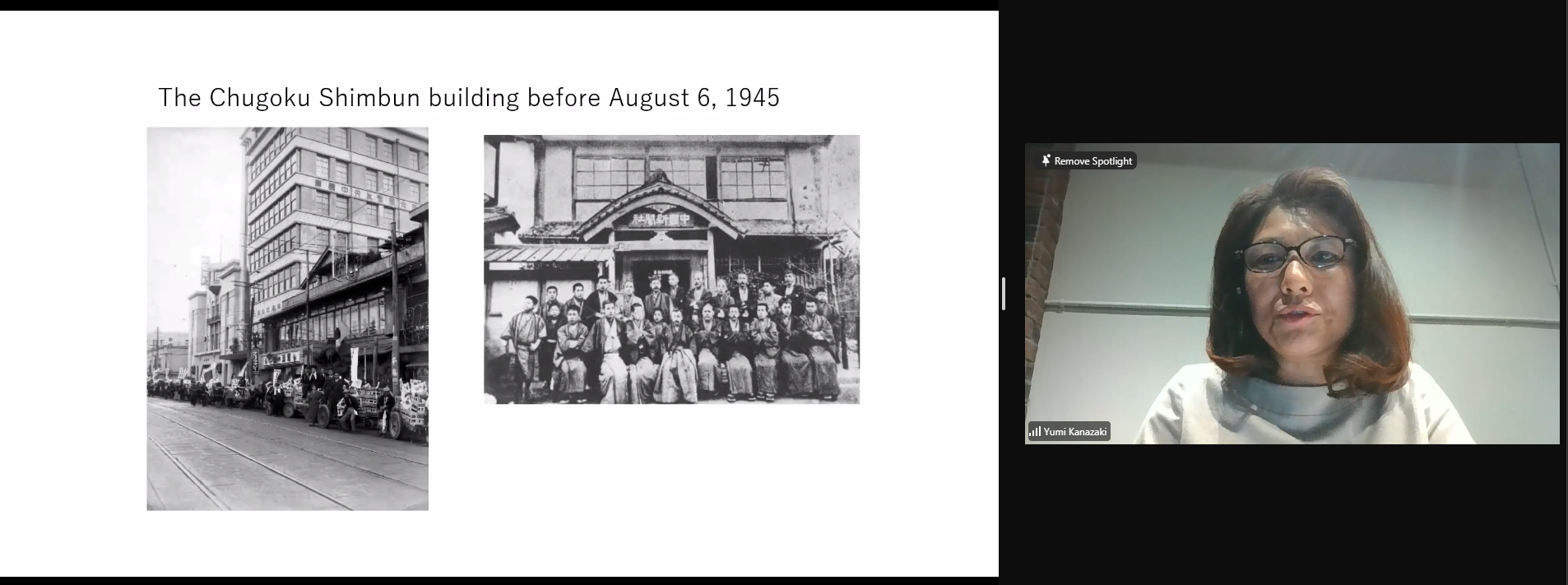
Ms. Yumi Kanazaki, Senior Staff Writer at Hiroshima’s Chūgoku Shimbun, presenting on peace journalism and the preservation of Hiroshima’s history and survivor testimony
A practice exchange explored how different forms of public engagement can move people from awareness to action. Mr. Takashi Arai, photographer and visual artist with To Hypocentre Collective, discussed how art and storytelling can create personal connections with difficult histories. He emphasized artists' responsibilities when representing experiences of violence, including reflecting on power, memory and whose stories are being told. Art can open space for empathy and dialogue, contributing alongside education and advocacy.
For youth advocacy, meaningful participation requires ownership and responsibility. Mr. Alisher Khassengaliyev, Co-founder of the Steppe Organization for Peace (STOP), emphasized that awareness alone is insufficient. He encouraged making disarmament relevant to everyday life, involving affected people as partners and giving young people practical responsibilities and support. These approaches can help people see a path from concern to action.
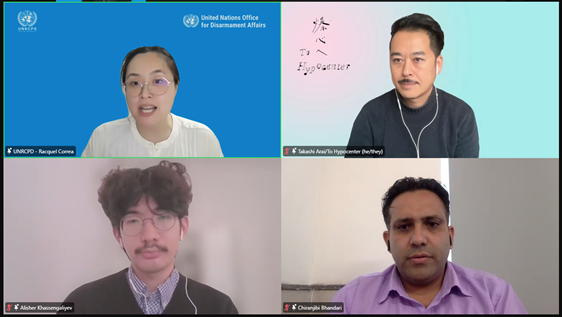
Ms. Racquel Gertrude Correa moderating a practice exchange with Mr. Takashi Arai, Mr. Alisher Khassengaliyev and Mr. Chiranjibi Bhandari on art, youth advocacy and peace education
Accessible education and practical skills were central to the contribution of Mr. Chiranjibi Bhandari, Assistant Professor at Tribhuvan University's Central Department of Conflict, Peace and Development Studies. He explained that people connect more readily with issues grounded in their own lives. His recommendations focused on human security, skill-building and inclusive networks that support continued learning and engagement.
Ms. Adaline Fulks, Political Affairs Intern at UNRCPD moderated the closing panel on rethinking disarmament and security. The discussion connected the enduring consequences of weapons with public health, environmental wellbeing and the governance of new technologies.
An intergenerational perspective came from Mr. Keita Takagaki, Coordinator of the Youth Community for Global Hibakusha and a descendant of atomic bombing survivors. He highlighted continuing physical, psychological and social harms, including questions of recognition and the experiences carried by survivors' families. His contribution emphasized that the consequences of nuclear weapons extend across generations and need to remain part of discussions about security.
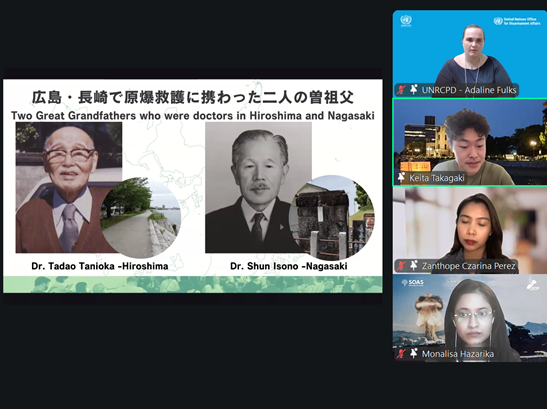
Mr. Keita Takagaki, Coordinator of the Youth Community for Global Hibakusha, sharing his family’s experiences of the atomic bombings of Hiroshima and Nagasaki
A One Health perspective connected human, animal and environmental health. Dr. Zanthope Czarina Perez, a licensed veterinarian and alumna of UNODA's Youth for Biosecurity Fellowship, explained how biological threats, food security and environmental contamination are connected concerns. She encouraged a broader understanding of security that includes public health and the ecological consequences of conflict.
The challenges posed by emerging weapons technologies were addressed by Ms. Monalisa Hazarika, Research and Strategic Engagement Officer at SCRAP Weapons. Discussing 3D-printed firearms, illicit production and ammunition management, she highlighted the importance of implementing and adapting existing frameworks. New technologies, her contribution showed, bring renewed attention to longstanding questions of oversight and responsibility throughout the weapons lifecycle.
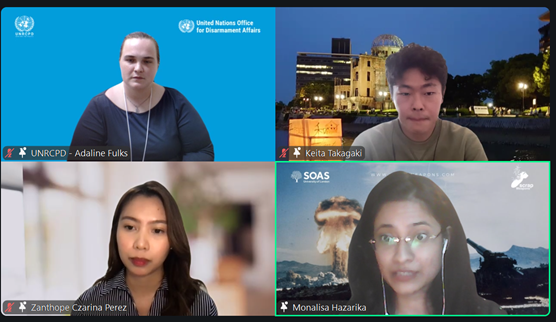
Ms. Adaline Fulks, Political Affairs Intern at UNRCPD, moderating a panel with Mr. Keita Takagaki, Dr. Zanthope Czarina Perez and Ms. Monalisa Hazarika on intergenerational nuclear harms, One Health and emerging weapons technologies
The exchanges offered participants several routes for continued engagement through education, reporting, research, creative practice and advocacy. They also emphasized the importance of giving young people and people affected by weapons opportunities to shape decisions and action.
As Chintan Girish Modi, a journalist, educator and peacebuilder from India, reflected: “My biggest takeaway was that you don't need to be an IR expert to work on disarmament. You can start where you are, regardless of your academic background.”
DTK 2026 concluded with encouragement to continue learning and bring disarmament into everyday work and public engagement. Across the six sessions, the programme connected international frameworks with the experiences of people affected by weapons and practical ways for participants to contribute to peace.
***
As we continue to strengthen future editions of the Disarmament Toolkit, we want to hear from you. What topics, regions or themes should we spotlight in 2027? Share your ideas at unrcpd-info@un.org. Your suggestions will help shape the next Toolkit and make future editions relevant to participants across the region and beyond.