A bomb that fails to explode can remain dangerous long after a war has ended. A weapon that selects and attacks a target without human intervention raises questions about control and responsibility. Both belong in the same conversation about how international rules can protect people from the harm weapons cause.
That conversation brought officials from across Asia and the Pacific together online on 28 October 2026. The United Nations Regional Centre for Peace and Disarmament in Asia and the Pacific (UNRCPD), working with the Convention on Certain Conventional Weapons Implementation Support Unit, hosted a briefing ahead of the Convention’s Seventh Review Conference, scheduled for 16–20 November in Geneva.
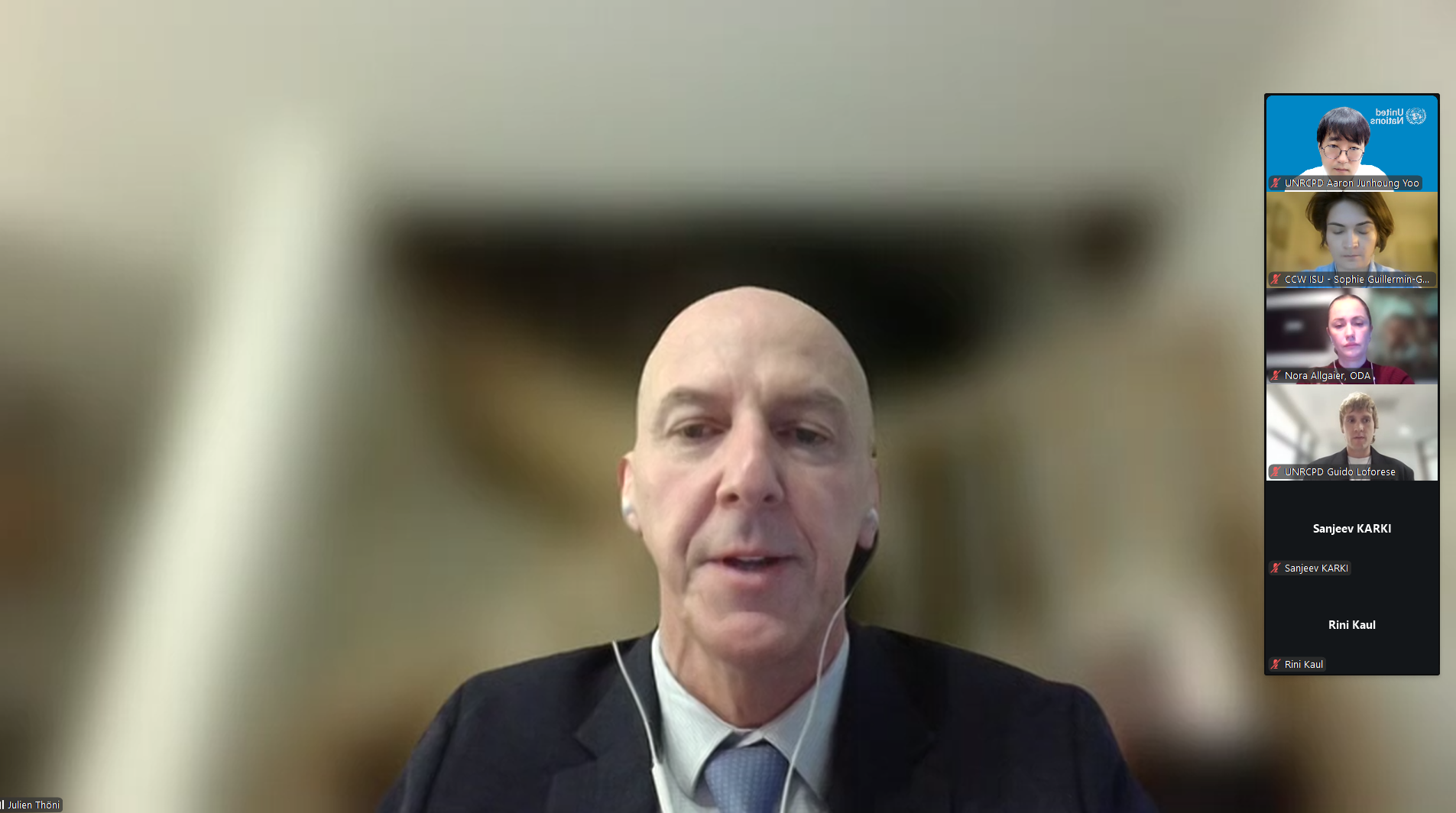
H.E. Mr. Julien Thöni, President-designate of the Seventh Review Conference of the CCW, briefed the participants about the key expectations for the upcoming review conference.
The Convention, usually called the CCW, starts from a straightforward idea: there are limits to the weapons that can be used in war and how they can be used. Those limits help protect civilians and prevent unnecessary suffering among combatants.
Adopted in 1980, the CCW is an international treaty that prohibits or restricts certain conventional weapons because of their humanitarian consequences. It brings governments together with legal, military and technical experts to consider how those protections work in practice and how they should respond as weapons change. “Conventional” distinguishes these weapons from weapons of mass destruction, such as nuclear, chemical and biological weapons.
The treaty has five sets of additional rules, known as Protocols. They address weapons that injure through fragments undetectable by X-rays; mines, booby-traps and other devices; incendiary weapons, designed primarily to set fires or cause burn injuries; blinding laser weapons; and explosive remnants of war. That last term covers unexploded and abandoned ammunition that can continue to threaten lives after fighting stops. Each Protocol tackles a particular source of harm.
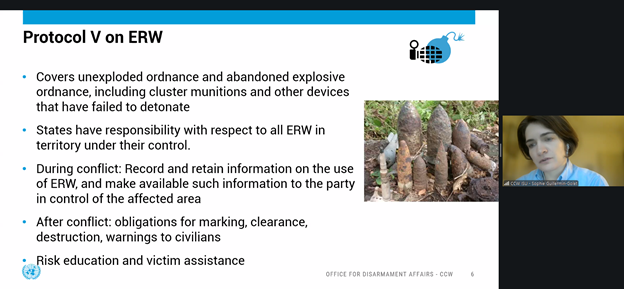
Ms. Sophie Guillermin-Golet introduced the Convention and its Protocols to the participants
This matters deeply in Asia and the Pacific. In countries such as Lao PDR, unexploded weapons from conflicts decades ago still endanger communities. Contaminated land can prevent families from farming safely, delay construction and make returning home dangerous. Rules addressing these hazards have a direct connection to people’s livelihoods and the opportunities available to the next generation.
Pacific communities face similar dangers. In Solomon Islands, unexploded bombs and shells from the Second World War remain near homes, gardens and coastal areas. Making land safe is part of enabling communities to build essential infrastructure and pursue development.
The region also has experience to contribute, including knowledge gained through clearance operations and efforts to rebuild affected communities. Participation in the CCW gives governments a way to bring that experience into international discussions, seek support and help shape responses to emerging concerns. As technologies evolve, the region’s perspectives on civilian protection and responsible weapons use belong in those discussions.
November’s Review Conference will give countries that have joined the Convention an opportunity to examine progress and agree on priorities for the years ahead. Ambassador Julien Thöni of Switzerland, the Conference’s President-designate, joined the briefing to explain what is at stake. He highlighted the CCW’s ability to address changing methods of warfare and encouraged wider participation, including engagement with countries that have yet to join.
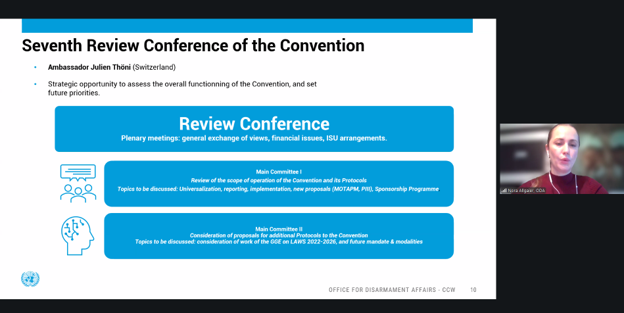
Ms. Nora Allgaier explained the procedural process of the upcoming Seventh Review Conference
Much of the briefing focused on lethal autonomous weapons systems, often shortened to LAWS. The term concerns weapons systems capable of identifying, selecting and engaging a target with lethal consequences without intervention by a human operator. This raises difficult questions about how people retain control over the use of force and who is responsible when things go wrong.
Juliana Helou van der Berg of the CCW Implementation Support Unit explained a development that will help frame the Geneva discussions. On 4 September 2026, the CCW’s Group of Governmental Experts on LAWS adopted a report by consensus, meaning no participating State objected to its adoption. It provides a shared basis for further work after years of discussion.
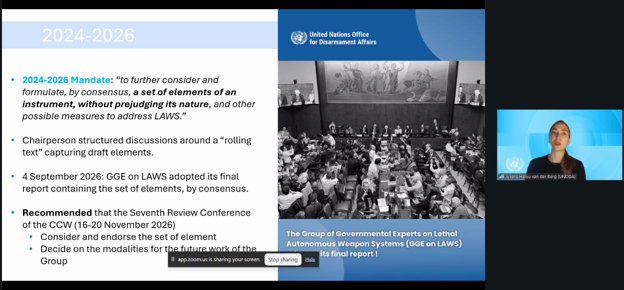
Ms. Juliana Helou van der Berg explained the outcome of the GGE on LAWS
The report brings together understandings on the systems under consideration, the law that applies to them, human judgement and control, safeguards, and accountability. International humanitarian law, which governs conduct during armed conflict, applies to these systems. Human judgement remains necessary to determine how a weapon can be used consistently with those rules.
In practical terms, this means examining a system’s capabilities and limitations, testing it carefully and considering the circumstances in which it might be used. Safeguards need attention throughout a weapon’s life, from development onwards. The discussions also addressed risks arising from biased data or from people placing too much trust in a machine’s outputs.
One point carries particular weight: accountability cannot be transferred to machines. Human responsibility remains central, even when technology performs functions that people once carried out directly.
The consensus report leaves important decisions open. Countries still differ over whether additional rules are needed and what form future work should take. The Review Conference will consider endorsing the agreed elements and deciding how discussions should proceed, with options including negotiations on a new Protocol or continued examination of legal, military and technical questions.
Alongside autonomous weapons, governments will review how existing commitments are being put into practice. Issues expected to feature include mines and incendiary weapons, the sharing of information on implementation, and ways to encourage more countries to join the Convention and its Protocols. These discussions keep attention on weapons whose humanitarian consequences are already well established.
The briefing also made the process easier to navigate. Nora Allgaier, Head of the CCW Implementation Support Unit, outlined the Conference arrangements and opportunities for officials outside Geneva to follow preparatory consultations online. Participants learned where to find documents and how to prepare for participation.
Support is available beyond the Conference itself. The Implementation Support Unit can help governments understand how to join the Convention, put its provisions into practice and meet reporting commitments. Eligible representatives may also receive assistance to attend meetings through the CCW Sponsorship Programme, including representatives of countries that have not yet joined.
For UNRCPD, the briefing was part of an ongoing effort to make international disarmament discussions more accessible to the region. The Centre remains available to connect States with information and expertise as they prepare for Geneva. Their contributions can help bring the experiences of affected communities, national authorities and regional specialists into decisions about how weapons are regulated and people are protected.
For more information please see the summary note here.
Contact unrcpd-info@un.org.